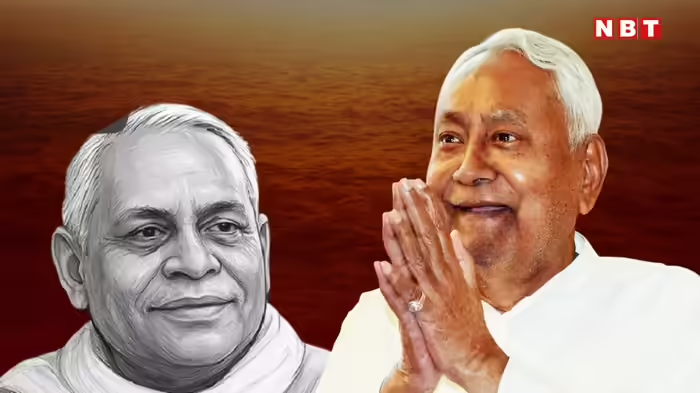
Patna: January 14 marks the birth anniversary of Bindeshwari Dubey, the former Chief Minister of Bihar, whose political journey is a story of resilience, dedication, and reformist zeal. Interestingly, Dubey took admission at the Bihar College of Engineering (now NIT Patna), the same institution from which current Chief Minister Nitish Kumar graduated.
Early Life and Education
Born in Mahuawa village of Shahpur in Bhojpur district, Dubey hailed from a modest farming family. Although his father expected him to assist in agriculture, Dubey showed exceptional academic promise from a young age. Determined to pursue education, he ran away to Patna and enrolled at the prestigious St. Michael’s School, living with his maternal uncle. Excelling in mathematics and physics, he supported his studies by teaching tuitions and later working night shifts at a small factory.
His academic brilliance earned him admission to the Bihar College of Engineering, where he studied during the 1942 Quit India Movement, eventually leaving his studies to join India’s freedom struggle under the inspiration of Mahatma Gandhi.
Entry into Politics
Post-independence, Dubey became active in the Indian National Congress, initially focusing on trade union politics. He rose to prominence as the national president of both the Indian National Trade Union Congress and the National Colliery Workers Union. Dubey first contested elections in 1952 from the Bokaro Bermo constituency and won, later being elected multiple times from Bermo (1962, 1967, 1969, 1972). In 1973, he became Education Minister under Kedarnath Pandey and also served in subsequent governments, eventually entering the Lok Sabha from Giridih in 1980.
Tenure as Chief Minister
Dubey assumed the office of Bihar Chief Minister in March 1985, serving for two years and ten months. His tenure was marked by decisive action against the coal mafia in Dhanbad, which drew opposition from entrenched political factions, particularly the Jagannath Mishra group. This political factionalism, combined with challenges in law and order, ultimately led to his resignation. Dubey resigned on February 13, 1988, following pressures from Congress high command under Prime Minister Rajiv Gandhi.
Political Challenges and Legacy
During his term, Dubey confronted caste-based violence and entrenched mafias while attempting to stabilize governance. Despite intense factional politics and challenges from rivals, he remained committed to reform and public service. His leadership left a lasting impact on Bihar’s political and labor landscape, reflecting the dedication of a self-made leader who rose from humble beginnings to the highest office in the state.
Bindeshwari Dubey’s life remains a remarkable narrative of education, activism, and governance, inspiring generations of leaders and citizens alike.
Discover more from SD NEWS agency
Subscribe to get the latest posts sent to your email.