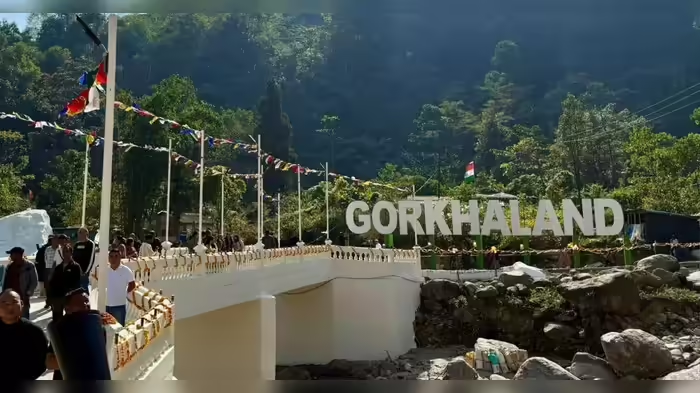
Guwahati | December 8, 2025 — In a remarkable display of community resolve, residents of Darjeeling have constructed a 140-foot bridge entirely through local contributions and voluntary labour, bypassing government agencies and ignoring state-level restrictions. The newly built structure, connecting Tungsung Tea Estate to Dhotrey Valley, has been symbolically named the “Gorkhaland Bridge,” giving fresh momentum to long-standing regional sentiments.
The bridge was inaugurated on Sunday and has quickly become a focal point of political conversation in the hills, especially ahead of the upcoming Bengal Assembly elections.
Community-Built, No Government Aid
Constructed over the Balason River, the bridge is the outcome of collective contributions by 29 local community organisations and the voluntary efforts of hundreds of residents. The initiative was coordinated with support from the Edwards Foundation and the Indian Gorkha Janashakti Front (IGJF), led by Ajay Edwards — who personally provided cement, iron rods, and other construction materials.
Local residents described the bridge as a “symbol of people’s determination,” built through shramdaan (voluntary labour) after repeated appeals to the Gorkhaland Territorial Administration (GTA) and the West Bengal government went unanswered.
Construction Began in January 2025
The project, which began in January 2025, was completed in nearly a year. Community leaders claim the bridge will drastically improve connectivity between Tungsung, a closed tea garden area, and Pokhriabong, located about 18 km from Darjeeling town.
Political analysts say that the naming of the bridge and the circumstances of its construction could have a ripple effect in the hills during the election season.
60-Foot Name Plaque Sparks Debate
A striking feature of the bridge is the installation of a giant 60-foot-high plaque bearing the name “Gorkhaland.” While the demand for a separate Gorkhaland state has lost momentum in recent years, the symbolism associated with the project has revived emotional undercurrents in the region.
Some political observers note that the decision to prominently display the “Gorkhaland” name may not sit well with all sections of the hill population. Yet, in a region where identity politics play a decisive role, such symbolism carries significant weight.
Political Undercurrents in the Hills
Ajay Edwards’ IGJF is currently the main opposition within the Gorkhaland Territorial Administration (GTA), which is ruled by the Bharatiya Gorkha Prajatantrik Morcha (BGPM) under Anit Thapa — a close ally of the Trinamool Congress (TMC). Though Thapa has never opposed the demand for Gorkhaland, the TMC stands firmly against any further division of West Bengal.
Edwards used the inauguration ceremony to highlight past sacrifices made during the Gorkhaland movement and asserted that the bridge stands as “proof of what unified Gorkha strength can achieve.” He also alleged multiple attempts to sabotage construction, including police intimidation and obstruction of material supplies.
Built Despite Government Restrictions
The construction was carried out despite a 2017 West Bengal government notification requiring prior permission for any bridge-building activity by non-government bodies. Under the guidelines, individuals or organisations must first apply through the Irrigation and Waterways Department’s portal.
A senior political observer noted that while the project did not receive government clearance, the inauguration went ahead because “no political outfit in the hills can be seen opposing sentiments linked to Gorkhaland.”
A Bridge Beyond Connectivity
For many locals, the Gorkhaland Bridge is more than just a physical structure — it is a declaration of identity, resilience, and regional aspiration. As political equations in Bengal evolve, the emotional resonance of this people-powered project is likely to shape discourse far beyond the hills.