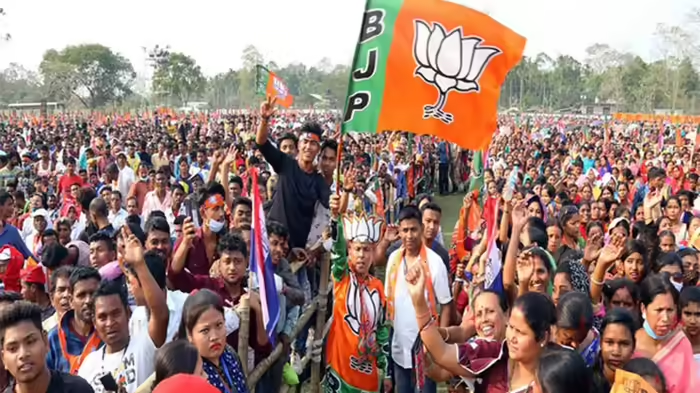
New Delhi: The recent municipal election results in Maharashtra have once again highlighted the changing dynamics of Indian politics, underscoring the growing dominance of the Bharatiya Janata Party (BJP). On January 16, the BJP secured 1,425 of the total 2,869 seats across 29 municipal corporations in the state—a near 50% strike rate.
The most significant development came from Mumbai, where the Brihanmumbai Municipal Corporation (BMC), a stronghold of Shiv Sena for 25 years, slipped out of regional control. Since 2014, the BJP has not entirely eliminated regional parties, but its sustained strategy has steadily curtailed their influence. By limiting regional parties’ ability to convert votes into seats and reducing their capacity to leverage state governments in national politics, the BJP has consolidated its position at the national level.
The Containment Strategy
The January 2026 municipal elections exemplify the BJP’s “containment operation” strategy. In Mumbai’s 227 wards, the BJP won 89 seats independently. With the support of ally Eknath Shinde’s Shiv Sena, the Mahajuti alliance crossed the majority mark. In contrast, Uddhav Thackeray’s Shiv Sena (UBT) was reduced to just 65 seats, down from over 130 in 2017. Elsewhere in the state, even traditional strongholds of the NCP in Pune and Pimpri-Chinchwad saw significant BJP gains. Analysts attribute this success to the “Triple Engine Government” narrative and welfare initiatives like “Majhi Ladki Bahin”, which appealed to women voters, as well as the support of 47% of voters aged 18–25. Political fragmentation within opposition parties further strengthened the BJP’s position.
Regional Parties in Bihar and Uttar Pradesh
The trend is not limited to Maharashtra. In Bihar and Uttar Pradesh, regional parties have also seen their influence wane. In Bihar’s 2025 assembly elections, the NDA won over 200 seats, with the BJP surpassing Nitish Kumar’s JD(U) to become the largest party for the first time. Although Tejashwi Yadav’s RJD received the highest vote share, it lagged in seats due to NDA’s welfare-driven campaigns and caste-neutral messaging, which disrupted long-standing social alliances. Similarly, in Uttar Pradesh’s 2024 Lok Sabha elections, parties like SP and BSP failed to retain their traditional influence, while welfare schemes like ration and housing programs, alongside the Ram Mandir issue, helped BJP secure a 36% vote share.
Rapid Erosion of Regional Dominance
The results from Delhi, Odisha, and Andhra Pradesh further show how quickly regional dominance can collapse. In Delhi’s 2025 assembly elections, the BJP won 48 seats, ending Aam Aadmi Party’s decade-long rule. In Odisha and Andhra Pradesh, BJD and YSR Congress could not defend their state governments. While Mamata Banerjee’s Trinamool Congress in West Bengal remains resilient, the BJP has emerged as the main challenger. South India remains an exception, with DMK in Tamil Nadu and the Left-Congress alliance in Kerala maintaining influence through linguistic identity and welfare politics.
BJP Emerges as the Strongest Party Nationwide
At the national level, the BJP now commands 1,654 legislators, the highest among all parties, while regional parties together account for only 31% of total legislators. The BJP’s strategy is clear: weaken identity-based politics through welfare schemes and exploit political fragmentation to undermine opposition. While regional parties have not vanished—they continue to win elections—their capacity to shape national politics through state power has been significantly curtailed. The coming years will reveal whether leaders like Mamata Banerjee and MK Stalin can defend their territories or if the BJP will push them to the margins as well.
Discover more from SD NEWS agency
Subscribe to get the latest posts sent to your email.