Patna:
The Supreme Court’s decision to stay the implementation of the University Grants Commission’s Promotion of Equity Regulation 2026 has sharply escalated political tensions in Bihar, turning an academic policy into a major ideological and electoral battleground ahead of the upcoming Uttar Pradesh and West Bengal assembly elections.
While opposition parties, particularly the Rashtriya Janata Dal (RJD), have termed the regulation an “election gimmick” of the Centre, leaders of the ruling NDA have welcomed judicial intervention, calling it necessary to preserve social harmony and cultural unity.
Over the past two days, protests against the regulation have continued in Patna, further intensifying the political atmosphere.
Political Crossfire Over UGC Rules
RJD leaders launched a sharp attack on the central government, questioning its intent behind introducing the regulation at a politically sensitive time.
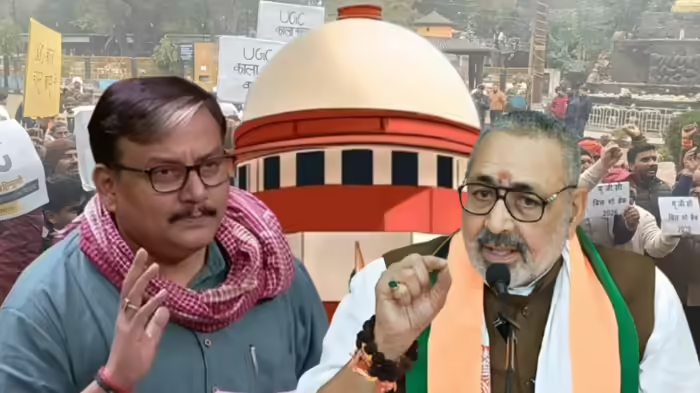
Rajya Sabha MP Manoj Jha, in a social media post, described “judicial neutrality” as a myth, indirectly criticising the use of legal mechanisms to maintain status quo. Party spokesperson Sarika Paswan alleged that the regulation was carefully designed keeping the UP and Bengal elections in mind, calling it a calculated political narrative rather than a genuine reform.
The party also used official police-related social media posts to mount indirect criticism, adding fuel to the controversy.
Why the Regulation Matters Politically
Opposition parties argue that by strengthening the anti-discrimination framework for Other Backward Classes (OBCs), the BJP aims to consolidate backward-caste voters in Uttar Pradesh and West Bengal — two states where caste equations play a decisive role in electoral outcomes.
Political analysts believe the move was intended to project the BJP as a champion of social justice, thereby attempting to weaken the traditional voter base of regional parties.
At the same time, the regulation has reportedly generated resentment among sections of the general category community, particularly in both poll-bound states. The opposition is now seeking to capitalise on this discontent by branding the move as “divisive politics” that threatens social balance.
NDA Hits Back at Opposition
Responding to the allegations, BJP spokesperson Prem Ranjan Patel accused Congress and RJD of exploiting Dalits and backward communities merely as vote banks for decades.
BJP MP Manan Kumar Mishra stated that the government and the UGC would present their position before the court, reiterating that no section of society would be subjected to injustice.
Union education ministry officials have also maintained that the regulation does not undermine merit or discriminate against any group.
‘Protection of Sanatan Values’ Argument
Deputy Chief Minister Samrat Choudhary said the government would comply with the Supreme Court’s directions while awaiting further clarification.
Union Minister Giriraj Singh, welcoming the court’s stay, described the regulation as potentially harmful to India’s cultural and social unity.
“This decision was necessary to protect Sanatan values and maintain social harmony,” Singh said, thanking Prime Minister Narendra Modi and Home Minister Amit Shah for their leadership.
Meanwhile, Lok Janshakti Party (Ram Vilas) MP Arun Bharti said the judicial process would ensure that all stakeholders receive a fair hearing.
From Policy to Poll Narrative
What began as a regulatory reform in higher education has now evolved into a full-fledged political narrative. With elections approaching in Uttar Pradesh and West Bengal, the UGC regulation has become a symbolic contest over social justice, identity politics, and ideological positioning.
Political observers believe the issue will continue to dominate public discourse in the coming weeks, shaping campaign rhetoric well beyond Bihar.
Discover more from SD NEWS agency
Subscribe to get the latest posts sent to your email.