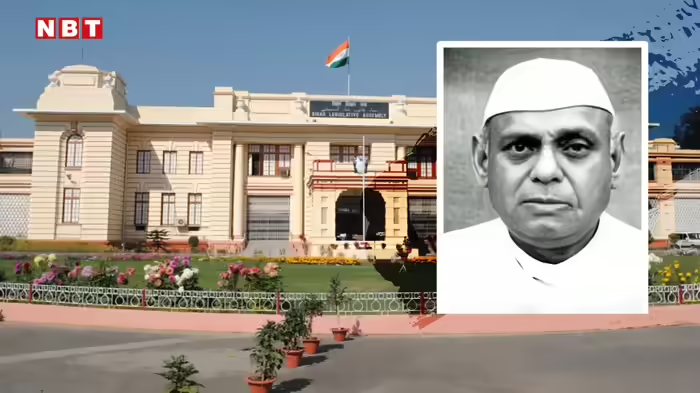
Patna, Bihar: January 28 is a landmark date in Bihar’s political history. On this day in 1968, the state witnessed its first-ever no-confidence motion that led to the fall of a non-Congress government. Mahamaya Prasad Sinha, a highly talented leader, had to resign as the Chief Minister due to political intrigues despite his remarkable credentials and public support.
From ICS to Mass Leader
Mahamaya Prasad Sinha had cleared the prestigious Indian Civil Services (ICS) exam in 1929, a career path that could have made him a District Magistrate or Collector. Yet, inspired by Subhas Chandra Bose, he left ICS to serve the nation, later joining Mahatma Gandhi’s civil disobedience movement. Initially a member of Congress, Sinha eventually embraced socialist ideals and became a leader for the masses.
Defeating the Sitting CM
In the 1967 Bihar Assembly elections, Congress won 128 seats but fell short of the majority mark of 160 in the 318-member house. Sinha, contesting as an independent, defeated sitting CM K.B. Sahay in Patna West, marking the first time a sitting Chief Minister lost an election. This victory propelled Sinha to prominence and established him as a political hero in Bihar.
The Reward of Leadership
Following his electoral triumph, Sinha joined Raja Kamakhya Narayan Singh’s Jan Kranti Dal, adding 13 legislators to the party. Alongside Jan Sangh (25), Praja Socialist Party (18), Communist Party (29), and 33 independents, the coalition laid the foundation for Bihar’s first non-Congress government. Although Karpuri Thakur of Praja Socialist Party was a strong contender for the CM post, Raja Kamakhya proposed Sinha for Chief Minister, honoring his feat of defeating a sitting CM. Sinha became CM, while Karpuri Thakur was appointed Deputy CM.
Challenges of a Coalition
Sinha’s government was a patchwork of parties, leading to internal contradictions. Three ministers—B.P. Mandal, Basant Narayan Singh, and Khalil Ahmad—were not members of the legislature. Four defected Congress MLAs were also inducted as ministers. B.P. Mandal, an MP from Praja Socialist Party, resigned after Sinha refused to make him a Legislative Council member within six months. Mandal joined hands with Jagdev Prasad, forming the Shoshit Dal, and began plotting against Sinha.
Congress Joins the Conspiracy
Congress, angered by Sinha’s formation of the Ayyar Commission to investigate corruption charges against K.B. Sahay and his ministers, also sought to bring down the government. Mandal demanded the CM post in return for his support. Despite internal opposition, the party aligned with Prime Minister Indira Gandhi’s wish to topple the Sinha government.
No-Confidence Motion Passed
On 15 January 1968, Congress, with support from Mandal’s faction, moved a no-confidence motion against Sinha’s government. On 25 January, the motion was voted on in the Assembly, with 163 votes in favor and 150 against, proving that Sinha had lost the majority.
Resignation on 28 January 1968
After failing the floor test, CM Mahamaya Prasad Sinha recommended dissolving the Assembly, but the Governor declined. On 28 January 1968, Sinha resigned as Chief Minister. On the same day, Satish Prasad Singh of the Shoshit Dal took oath as the new CM, marking a historic transition in Bihar politics.
Discover more from SD NEWS agency
Subscribe to get the latest posts sent to your email.