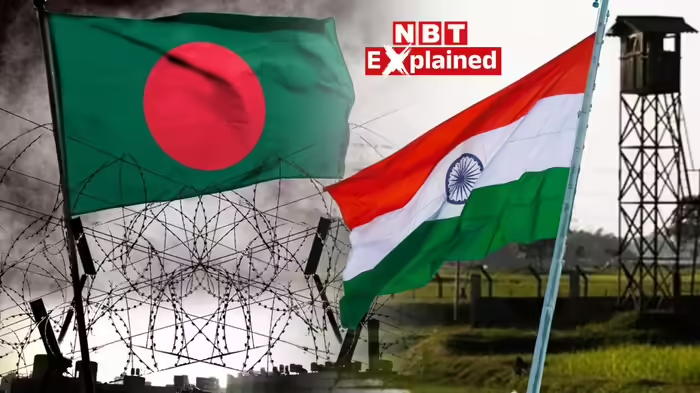
New Delhi: Since the political upheaval in Bangladesh that led to Sheikh Hasina stepping down, Pakistan and its intelligence agency, Inter-Services Intelligence (ISI), have been steadily increasing their influence in the country. India is closely monitoring these developments amid rising concerns over strategic and security threats.
ISI Presence in Dhaka
Reports indicate that Pakistan’s ISI has established an active network in Dhaka, following the recent visit of General Sahir Shamshad Mirza, Chairman of Pakistan’s Joint Chiefs of Staff Committee. During this visit, Dhaka reportedly approved the posting of intelligence officials in the Pakistani High Commission, signaling a deepening ISI footprint in the Bangladeshi capital.
Emerging Security Collaboration
Strategic expert Brahma Chellaney has noted that since the last year’s regime change in Dhaka, Bangladesh and Pakistan have quietly expanded defense and intelligence cooperation. The collaboration involves sharing intelligence on airspace monitoring over the Bay of Bengal and India’s eastern front. Joint military exercises, training, and capacity-building initiatives between the two countries indicate a nascent security alliance that has significant implications for India.
Pakistan Allegedly Influencing Bangladesh’s Politics
Former Indian diplomat Veena Sikri has accused Jamaat-e-Islami Bangladesh of acting under Pakistan’s directives during recent anti-India protests at Indian missions in Rajshahi and Khulna. She alleged that Pakistan is attempting to exert control over the Bangladeshi military and install a puppet government led by Jamaat-e-Islami.
According to DNA reports, Bangladesh is scheduled to hold a referendum and elections on 12 February 2026, including the controversial July Charter. While India has engaged with the Bangladesh Nationalist Party (BNP), ISI is reportedly funding opposition groups, including the National Citizen Party (NCP), which spearheaded nationwide protests against Sheikh Hasina’s government last year.
Rising Domestic Extremism
Academics and security analysts have highlighted that extremist elements, emboldened by political instability, are increasingly vocal. Arifa Rehman Ruma, Associate Professor at Bangladesh Open University, stated that political actors such as Hasnat Abdullah openly called for the expulsion of the Indian High Commissioner, reflecting a dangerously permissive environment for radical ideologies.
India’s Strategic Concerns
The Parliamentary Standing Committee on External Affairs, chaired by Congress MP Shashi Tharoor, warned that Bangladesh’s current trajectory represents India’s most significant post-1971 strategic nightmare. The committee highlighted rising Chinese and Pakistani influence, generational political divides, and weakening law-and-order as pressing concerns for New Delhi.
With ISI activity intensifying and domestic radicalization on the rise, India remains on high alert, closely monitoring developments to safeguard its strategic and security interests in the region.
Discover more from SD NEWS agency
Subscribe to get the latest posts sent to your email.