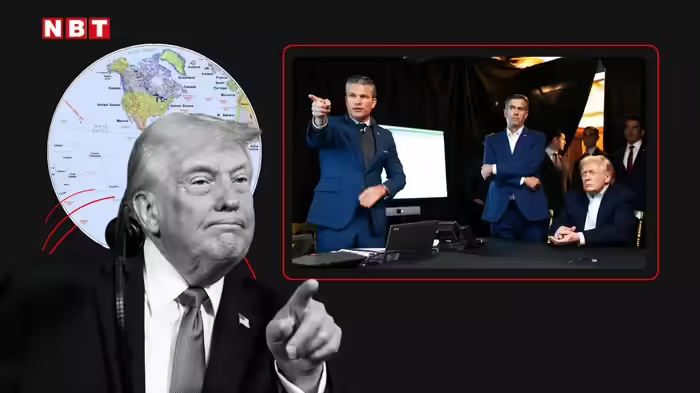
The dramatic arrest of Venezuelan President Nicolás Maduro by US forces has sent shockwaves across the global political landscape. Once again, the United States has acted unilaterally in the name of security, democracy, and freedom—values it frequently champions on the world stage. But President Donald Trump’s latest remarks suggest something far more ambitious, and far more dangerous, may be underway.
During a press conference following the Venezuela operation, Trump invoked what he called the “Donroe Doctrine”, a modern reinterpretation of the centuries-old Monroe Doctrine, signaling a hardline approach to asserting US dominance across the Western Hemisphere.
From Monroe to “Donroe”
The original Monroe Doctrine, articulated in 1823 by President James Monroe, warned European powers against further colonization or interference in the Americas. Over time, it became the ideological justification for repeated US interventions in Latin America.
Trump now appears to be reviving—and radicalizing—that doctrine.
“From the time of the Monroe Doctrine, this has been our hemisphere,” Trump said, accusing China, Russia, and Iran of expanding influence over Venezuela’s oil industry. “That violates the fundamental principles of American foreign policy that are more than 200 years old. We let it go for too long. Now it’s back. Some people are calling it the Donroe Doctrine.”
A Hemisphere Under Watch
The US State Department reinforced this message in a post on social media platform X, declaring:
“This is our hemisphere. President Trump will not allow threats to America’s security.”
Secretary of State Marco Rubio echoed the sentiment, stating that Washington would not allow adversaries or rivals to use the Western Hemisphere as an operational base against US interests.
Critics, however, see troubling parallels. Russia justified its invasion of Ukraine using similar logic—claiming security threats near its borders. Yet Washington has condemned Moscow for the same reasoning it now appears to embrace.
Who Could Be Next?
With Venezuela already under direct US action, analysts believe several countries could now be in Washington’s crosshairs:
- Greenland: Trump has openly expressed interest in controlling Greenland, citing its strategic importance in the Arctic. The island belongs to Denmark, a NATO ally, raising fears of an unprecedented intra-NATO confrontation.
- Colombia: Trump has publicly warned Bogotá that it could face consequences similar to Venezuela if it fails to align with US expectations.
- Cuba: Trump has declared that the Cuban government is “close to collapse,” reigniting fears of renewed US intervention.
These statements have fueled speculation that the United States may seek to reshape governments, directly or indirectly, across the region to restore what it calls hemispheric dominance.
A Policy Rooted in History—and Controversy
According to the US State Department’s own historical records, the Monroe Doctrine has previously been used to justify interventions in Cuba, Nicaragua, Haiti, and the Dominican Republic.
Trump’s National Security Strategy, released in November, explicitly states that the US will “reassert and enforce the Monroe Doctrine” to protect American access and influence in critical regions of the Western Hemisphere.
Critics argue this signals a return to regime-change politics, where governments unwilling to submit to US pressure may face economic warfare, covert operations, or even direct military action.
A New Era of American Power Projection?
Supporters of Trump see the Donroe Doctrine as a necessary response to rising global competitors like China and a way to reassert American strength. Opponents warn it could destabilize entire regions, undermine international law, and push the world toward a more confrontational and fragmented global order.
As silence from many world leaders continues—perhaps out of fear of Washington’s reaction—one question looms large:
Is the United States entering a new era where sovereignty in the Western Hemisphere exists only with American approval?
The answer may soon emerge—not in speeches, but in the next country where power changes hands.
Discover more from SD NEWS agency
Subscribe to get the latest posts sent to your email.