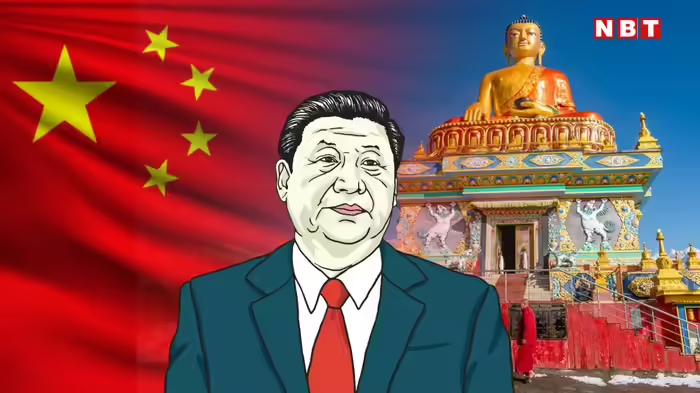
New Delhi: China’s President Xi Jinping has sent a strong message to the world as the New Year begins, emphasizing that the reunification of the motherland “cannot be stopped.” While Xi did not explicitly mention India, analysts suggest that his words and the choice of terminology—“Motherland” and “Reunification”—carry subtle signals of intimidation, with potential implications for India’s Arunachal Pradesh.
This statement comes immediately after China conducted military drills near Taiwan, drawing international attention and criticism from countries including Japan and Australia. Despite global protests, Beijing dismissed concerns, framing them as “irresponsible.”
China’s Hidden Ambitions
While China publicly asserts claims over Taiwan, it also maintains its longstanding claim on Arunachal Pradesh, referring to it as “South Tibet” or Zangnan. The Chinese government frequently alters place names in the region on its maps and reacts strongly to visits by Indian leaders, including the President and Prime Minister, to Arunachal Pradesh. Experts warn that Xi’s message should not be dismissed as merely directed at Taiwan, as it may signal China’s broader territorial ambitions in the region.
US Reports Echo Concerns
A recent US report highlights China’s growing interest in Arunachal Pradesh, warning that it could become a flashpoint in India-China relations. Washington has reaffirmed its stance that Arunachal Pradesh is an integral part of India and opposes any Chinese claims beyond the Line of Actual Control (LAC).
Arunachal Has Never Been Part of Tibet
India maintains that Arunachal Pradesh is an integral and inalienable part of its territory, a claim repeatedly reinforced by the 14th Dalai Lama. While China occupied Tibet in 1950, Arunachal Pradesh was never under Tibetan control.
Strategic Border Perspective
Arunachal Pradesh shares borders with three international regions: approximately 1,200 km with Tibet, 150 km with Bhutan, and 550 km with Myanmar. Arunachal’s Chief Minister Pema Khandu has emphasized that India shares no direct border with China outside Tibet, underscoring India’s sovereign control over the state.
Xi Jinping’s New Year message, combined with China’s military posturing near Taiwan, has heightened regional vigilance, signaling that India must remain alert to potential Chinese attempts at expanding territorial influence under the pretext of reunification.
Discover more from SD NEWS agency
Subscribe to get the latest posts sent to your email.