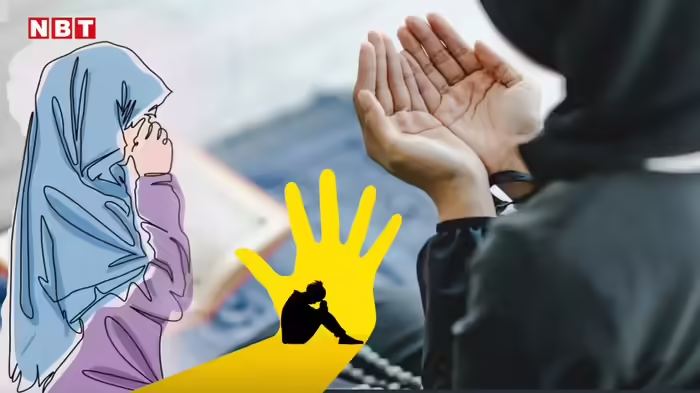
Amroha, Uttar Pradesh: The Uttar Pradesh Police registered an FIR on December 9, 2025, involving allegations that go beyond the immediate scope of the triple talaq law, exposing a grey area in legal and social practices that often goes unaddressed. A woman from Amroha has alleged that immediately after being divorced through triple talaq, she was forced to undergo ‘halala’ multiple times under coercion in order to remarry her husband.
What is the Case About?
According to the victim, her husband, brother-in-law, and certain clerics compelled her to undergo ‘halala’ several times to make her eligible for remarriage. Halala is a controversial practice in which a divorced woman must marry another man and engage in intimate relations before she can remarry her previous husband. The woman claimed that under the pretext of halala, she was subjected to repeated sexual assault.
Police Action and Legal Provisions
The police have registered cases under the Muslim Women (Protection of Rights on Marriage) Act, 2019, Sections 3 and 4, which criminalize instant triple talaq. In addition, charges related to rape and criminal intimidation have been invoked. Following preliminary investigation, provisions of the POCSO Act were also added, as the victim revealed she was married off forcibly in 2015 at the age of 15. The main accused husband has been arrested, while a hakim (traditional healer) and the husband’s cousin remain at large.
Victim’s Account
The victim, identified as Zubaida (name changed), a former student of a reputed school in Aligarh, comes from a well-established family. She told the police that she was given triple talaq twice—in 2016 and 2021—and was forced into halala on three separate occasions under duress. Zubaida said, “Every time it felt like I was being handed over to someone else. I was so ashamed that I could not share this with anyone, and I did not want my daughter to ever know.”
Legal Challenges and Expert Opinions
Experts highlight this case as indicative of significant gaps in Indian law. The 2019 triple talaq law criminalizes instant divorce but makes no mention of halala, nor does it regulate or recognize the practice. Social activist Zakia Soman commented, “Halala is not mentioned in the Quran. It survives due to patriarchal misinterpretations, and women often stay silent out of fear or shame.” Another activist, Naish Hasan, noted that the absence of documented records of marriage and divorce makes it extremely difficult for women to seek justice in such cases.
While the husband is in jail, he has filed a counter-complaint alleging false charges and intimidation by his wife. Petitions challenging the practice of halala are still pending before the Supreme Court.
Discover more from SD NEWS agency
Subscribe to get the latest posts sent to your email.