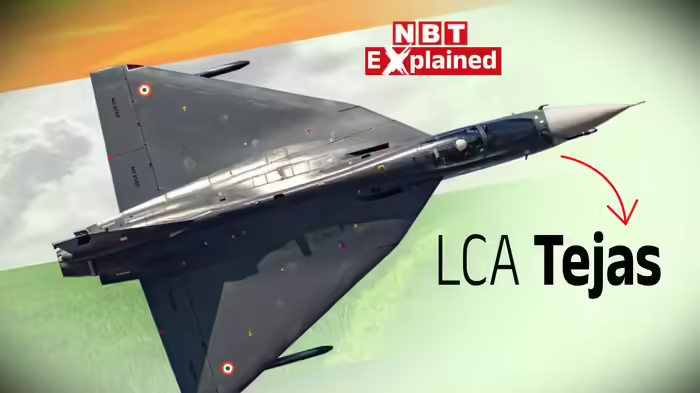
Over the past two decades, the Indian Air Force (IAF) has witnessed the retirement of several fighter aircraft while struggling to induct new ones in sufficient numbers. Since the induction of the Sukhoi-30MKI, there has been no major addition to India’s frontline fighter fleet—until now.
On September 25, 2025, the IAF placed an order for 97 additional Light Combat Aircraft (LCA) Tejas Mark-1A, estimated at ₹62,370 crore. This marks the fourth order for the Tejas, reflecting India’s growing reliance on indigenously developed defense platforms. Once inducted, these aircraft are expected to form the backbone of India’s airpower, with a total of 220 Tejas jets joining the fleet—making it the second-largest combat aircraft formation after the Sukhoi-30MKI.
Tejas: The Backbone of IAF
According to a report by the Observer Research Foundation, the LCA program was initiated in the early 1980s as a replacement for the aging MiG-21 series and the Ajit fighter. Despite significant delays in development, the Tejas has now become a crucial asset for the IAF, especially as squadron strength has declined over the years. Initially, the IAF was reluctant to embrace Tejas due to its inability to fully meet Air Staff Requirements (ASR). However, in 2021, the perspective changed significantly when the IAF placed a first major order of 83 Tejas Mark-1A jets worth ₹48,000 crore, marking a historic milestone in India’s defense aviation sector.
Why Inducting Tejas in Large Numbers Became Necessary
Inducting a large number of Tejas jets was an unavoidable decision. The IAF and the Ministry of Defense were exploring both imports and domestic production to address the shortfall caused by the retirement of the MiG-21 fleet and other aging aircraft. With the sanctioned squadron strength dropping from 42 to around 29, bolstering numbers with Tejas became critical.
Foreign Jets: A Complicated Alternative
A key reason for the fighter aircraft shortfall is the long-pending Medium Multi-Role Combat Aircraft (MMRCA) tender, which failed to deliver a single aircraft out of the proposed 100+ modern jets. Although 36 Rafale jets were inducted through a government-to-government agreement in 2016, the IAF’s fleet numbers have continued to dwindle. Recent reports indicate that the IAF has proposed 114 more Rafale jets for acquisition under a similar G2G arrangement instead of opening a fresh tender process.
Su-30MKI Purchases: A Partial Solution
Given current orders and Dassault Aviation’s production capacity, it could take nearly a decade for domestically produced Tejas jets to be fully operational. The IAF has also considered additional Su-30MKI acquisitions as an alternative. However, the Sukhoi-30MKI does not fully meet the IAF’s requirements for medium-weight, cost-effective multi-role aircraft with high operational readiness.
Engine Supply Delays Add Pressure
Delays in engine supply from General Electric, a key component of the MMRCA plan, have added further complexity. In this context, Tejas remains the only near-term solution to address the worrying decline in squadron strength while simultaneously enhancing India’s domestic defense capabilities.
Discover more from SD NEWS agency
Subscribe to get the latest posts sent to your email.