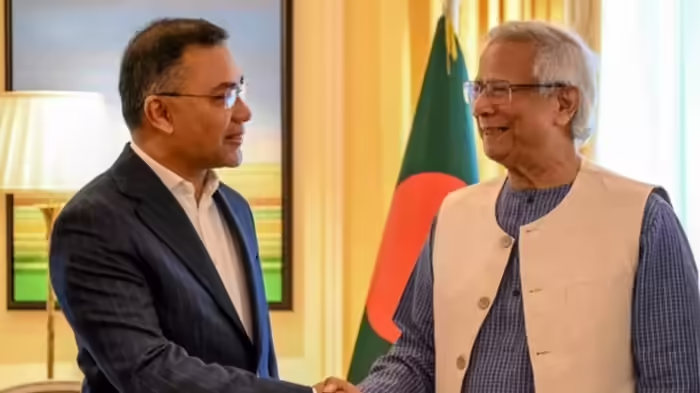
The recent elections in Bangladesh have introduced a significant turning point in South Asian politics, offering an opportunity for political renewal and potentially a fresh start in India-Bangladesh relations. After a prolonged period of political uncertainty and a challenging interim government, the country now has an elected government in place, restoring institutional stability and reinforcing regional confidence. The Bangladesh Nationalist Party (BNP) has secured a clear electoral mandate, aided in part by the exclusion of the Awami League from the electoral process.
Remembering the Past
Ahead of the elections, BNP leader Tariq Rahman conveyed positive signals regarding India. The party recognizes that Bangladesh’s progress is closely linked to constructive relations with its neighbor. However, the memories of BNP’s previous tenure remain. Between 2001 and 2006, under the leadership of Tariq Rahman’s mother, Khaleda Zia, the BNP government pursued policies that were often India-critical. While it would be incorrect to assume that history will automatically repeat itself, the current circumstances suggest a possibility for renewed engagement in a different direction.
Challenges Ahead
The geopolitical and economic landscape of South Asia has changed considerably since the early 2000s. India has emerged as the region’s largest economic power, deeply integrated into global supply chains and widely regarded as a driver of development for neighboring countries. Meanwhile, Bangladesh faces significant economic pressures, with external debt surpassing $100 billion and foreign reserves having nearly halved over the past four years. In this context, regional cooperation becomes imperative for Bangladesh.
Signals and Warnings
Bangladesh’s stability will depend on whether BNP can build a broad and inclusive coalition that reflects the spirit of the 1971 Liberation War, rather than relying solely on its electoral victory. In the recent elections, Jamaat performed impressively, and the National Citizen Party (NCP), formed from the July 2024 movement, also participated. Although the NCP’s performance fell short of expectations, youth radicalization signals an important caution for the new government.
Policy Decisions in Focus
In the coming months, it will become clear whether BNP can chart policies that balance ideological pressures with economic necessities. During the election campaign, Tariq Rahman employed positive rhetoric regarding India, but the true test will lie in policy decisions.
Domestic Imperatives
Bangladesh’s economic ambitions—restoring investor confidence, stabilizing the economy, and addressing unemployment—are directly tied to regional connectivity and trade. India’s growing economic role in South Asia presents opportunities that the new Bangladeshi leadership could leverage. Strong ties with India may not only serve diplomatic goals but also strengthen domestic political legitimacy by delivering on public expectations.
India’s Approach
India’s policy toward Bangladesh is generally cautious and long-term, focused on stability and mutual benefit. With deeply interconnected borders and shared interests in trade, economic development, and security, India’s engagement will continue to prioritize collaboration on cross-border security, countering extremism, and enhancing regional connectivity.
The Need for Caution
Bangladesh must avoid becoming entangled in any anti-India schemes orchestrated by Pakistan. The protection of minority communities in Bangladesh will also impact bilateral relations. If the new government addresses India’s security concerns responsibly, New Delhi should reciprocate with constructive cooperation. The significance of this election extends beyond the margin of victory; it lies in the political decisions that follow. Bangladesh stands at a crossroads where the government’s choices will determine whether the country moves toward lasting stability or risks renewed instability.
Discover more from SD NEWS agency
Subscribe to get the latest posts sent to your email.