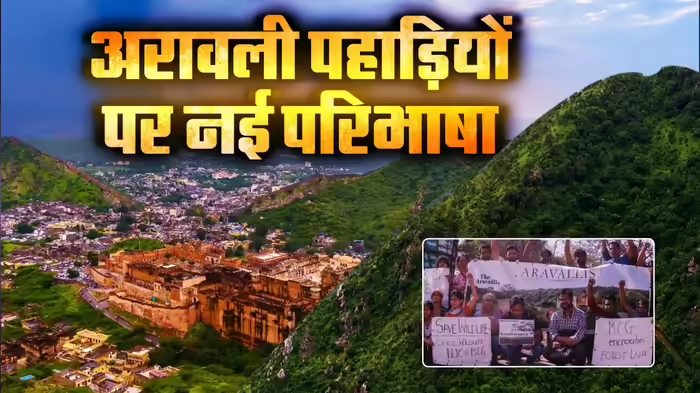
New Delhi: India’s oldest mountain range, the Aravalli Hills, is once again at the heart of a national debate. The Supreme Court recently approved a new legal definition for the Aravallis, triggering questions and concerns across environmental circles. Here’s what you need to know.
1. What is the new legal definition of the Aravalli Hills?
In November–December 2025, the Supreme Court accepted the central committee’s proposed definition: only hills rising at least 100 meters above ground will now be officially considered part of the Aravalli range. Previously, different states had varying regulations regarding the Aravallis, creating legal ambiguities. The new definition aims to standardize protection across five states where the range spans.
2. Why are environmentalists concerned?
According to an internal report by the Forest Survey of India, out of 12,081 mapped hills, only 1,048 meet the 100-meter benchmark—roughly 8.7%. This implies that nearly 90% of the Aravalli area could lose legal protection, opening it up for mining. Destruction of these smaller hills could disrupt the continuity of the Aravalli range, creating larger ecological gaps.
3. Why is mining not completely banned?
The Court noted that past experiences of complete mining bans were ineffective, leading to a rise in illegal mining and sand mafia activity. Instead, it opted for a balanced approach: strict regulations are in place, but mining continues under controlled conditions. No new mining approvals have been issued as of now.
4. Why are the Aravalli Hills important?
The Aravalli range, about 20 crore years old, prevents the Thar Desert from spreading eastwards into Rajasthan, western Uttar Pradesh, Haryana, and Delhi NCR. These hills recharge groundwater, support biodiversity, and serve as key water sources for rivers like Chambal, Sabarmati, and Luni. Minerals such as lead, zinc, copper, gold, sandstone, limestone, marble, and granite are also found here.
5. What would be the consequences of losing the Aravalli Hills?
Deforestation or destruction of the Aravallis would worsen dust pollution, water scarcity, extreme weather, and heat stress for millions in northwest India. The hills help maintain rainfall patterns, prevent droughts, and provide habitats for wildlife. Their loss could increase human–wildlife conflict and disrupt regional climate balance.
6. What actions have been taken against mining?
In the 1990s, the Ministry of Environment tightened mining rules, allowing extraction only under existing projects. In 2009, the Supreme Court imposed a full ban on mining in Faridabad, Gurgaon, and Mewat. In 2024, the Court prohibited granting new leases or renewing old ones, instructing the Central Empowered Committee (CEC) to conduct studies. The CEC recommended scientific mapping, micro-level environmental impact assessments, and halting mining in eco-sensitive zones. The Court accepted these recommendations in November 2025. Additionally, the central government launched the Aravalli Green Wall Project in June 2025 to increase green cover in a five-kilometer buffer zone across 29 districts.