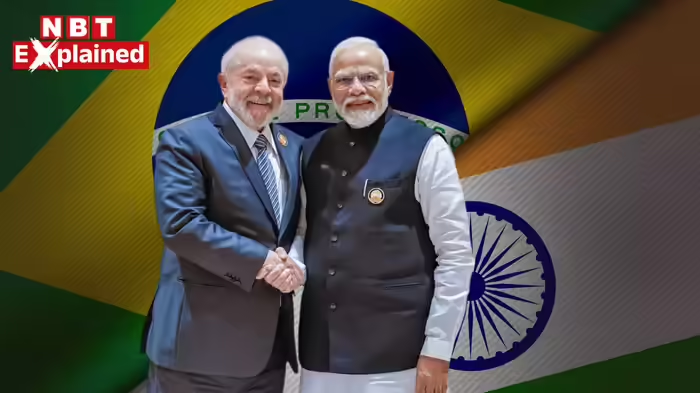
Brazilian President Luiz Inácio Lula da Silva’s upcoming visit to India in February, ahead of the BRICS Summit later this year, is far from routine. With India set to host and chair the BRICS Summit, Lula’s early arrival underscores the growing strategic convergence between India and Brazil, particularly on leadership of the Global South amid rising global uncertainty.
President Lula is scheduled to visit India from February 19 to 21 and is likely to participate in the Artificial Intelligence (AI) Summit in New Delhi, which will also see the presence of several global leaders, including French President Emmanuel Macron. However, diplomats and strategic experts note that Lula’s visit carries significance well beyond the AI summit, positioning India and Brazil as key partners shaping the future agenda of the Global South.
Shared Stand on Global Trade and Tariffs
India and Brazil are among the countries most affected by the tariff policies of former US President Donald Trump. Lula has emerged as one of the strongest critics of these tariff measures, which have disrupted global trade and disproportionately impacted emerging economies. Against this backdrop, his engagement with India gains added importance.
Prime Minister Narendra Modi, after speaking with Lula on the phone, highlighted this shared vision, stating that close cooperation between India and Brazil is essential to advance the common interests of the Global South.
BRICS and the Push for Multipolarity
Both India and Brazil are founding members of BRICS and have consistently advocated reforms in global governance institutions, including the United Nations Security Council, while strongly supporting multilateralism. One of BRICS’ key agendas has been exploring alternatives to the US dollar for intra-bloc trade—a move that has drawn sharp reactions from Washington.
Last year, the imposition of steep tariffs on India and Brazil was widely seen as being linked to BRICS’ growing economic assertiveness. With India hosting the BRICS Summit this year, Lula’s visit is expected to help align positions and strengthen coordination ahead of crucial decisions.
Visit Amid Global Uncertainty
Lula’s India trip comes at a time of heightened global instability driven by shifting US foreign and economic policies. From aggressive tariff actions to controversial positions on regions ranging from Venezuela to Greenland, and lingering tensions in West Asia, global alignments are under strain. Even traditional US allies in Europe and NATO are reassessing their strategic positions.
In this volatile environment, India and Brazil have cautiously maintained strategic autonomy. Notably, both countries have distanced themselves from recent US initiatives, including proposed peace frameworks in conflict zones, reflecting their preference for independent, balanced diplomacy.
Strategic Convergence Between India and Brazil
India and Brazil share several historical and structural similarities. Both nations emerged from colonial rule, uphold vibrant democracies, and possess large domestic markets driven by significant populations. Their industrial development trajectories also show notable parallels.
Experts see immense potential for deeper cooperation in areas such as defence, food security, energy, technology, and industrial partnerships. These complementarities enhance the geopolitical relevance of both countries in shaping current and future global dynamics.
Preparing to Lead the Global South
With the recent expansion of BRICS, the partnership between India and Brazil has become even more critical. BRICS countries together account for nearly half of the world’s population and around 40% of global GDP. This scale provides a strong platform for collective leadership of the Global South.
Lula da Silva’s visit, therefore, is being seen as a strategic step toward consolidating this leadership. As India prepares to host the BRICS Summit, closer coordination with Brazil could play a decisive role in defining a more balanced, inclusive, and multipolar global order.
Discover more from SD NEWS agency
Subscribe to get the latest posts sent to your email.