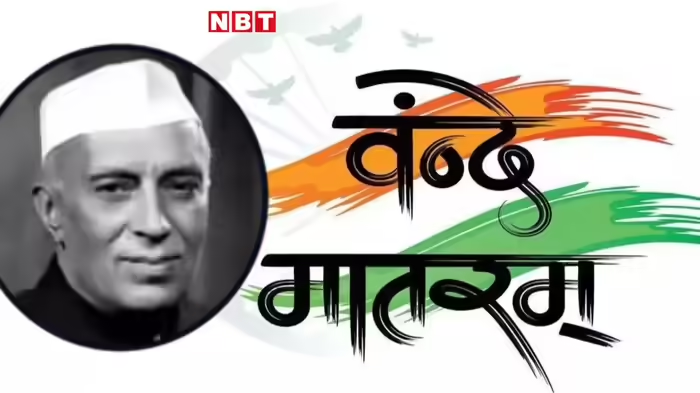
New Delhi: As Parliament gears up for a 10-hour discussion on the 150th anniversary of ‘Vande Mataram’, attention has turned once again to Jawaharlal Nehru’s decision to select ‘Jan Gan Man’ as India’s national anthem. BJP leaders claim the debate will shed light on why Nehru did not designate ‘Vande Mataram’ as the national anthem, highlighting historical considerations from 1948.
Nehru’s Reasons: Music, Language, and Global Acceptance
Nehru’s arguments, preserved in his letters and speeches, were primarily musical, linguistic, and international in nature, and also reflected a distinction between the national song and the national anthem.
In a Cabinet note dated 21 May 1948, Nehru wrote that a national anthem should not only have words but also a melody suitable for orchestras, military bands, and various formal occasions. While he acknowledged the beauty of ‘Vande Mataram’, he considered its tune slow, repetitive, and lament-like, making it difficult for foreign bands or audiences to adopt.
Nehru emphasized that a national anthem should celebrate achievements and inspire confidence, unlike ‘Vande Mataram’, which was deeply tied to the struggle for independence. He also noted that the language of ‘Vande Mataram’ could be difficult for the general population, whereas ‘Jan Gan Man’ was comparatively simpler and more accessible, though it might require minor adaptations over time.
Correspondence with Leaders
In a letter to B.C. Roy, then Chief Minister of Bengal, dated 15 June 1948, Nehru clarified that the decision was not influenced by opposition from any community. Rather, he argued that ‘Vande Mataram’ was more suitable as the national song, linked deeply with India’s independence movement, while the national anthem should reflect accomplishment and aspiration.
Similarly, in a letter to Shyama Prasad Mukherjee on 21 June 1948, Nehru reiterated that while ‘Vande Mataram’ was emotionally powerful, its melody was unsuitable for orchestras and international audiences, whereas ‘Jan Gan Man’ could immediately appeal both domestically and abroad.
Vande Mataram Remains India’s National Song
On 25 August 1948, responding in the Constituent Assembly, Nehru affirmed that ‘Vande Mataram’ would continue as India’s primary national song, but the national anthem needed to meet international musical standards. ‘Jan Gan Man’ fulfilled these requirements, making it easily playable in both Indian and Western musical styles, unlike ‘Vande Mataram’.
Nehru also made it clear that the final decision rested with the Constituent Assembly, which could choose to retain ‘Jan Gan Man’ as the national anthem, keep ‘Vande Mataram’ as the national song, or select an entirely new song and tune.
In essence, Nehru’s rationale for choosing ‘Jan Gan Man’ over ‘Vande Mataram’ revolved around musical adaptability, language simplicity, international acceptance, and the different emotional tone required for a national anthem versus a national song.
Discover more from SD NEWS agency
Subscribe to get the latest posts sent to your email.