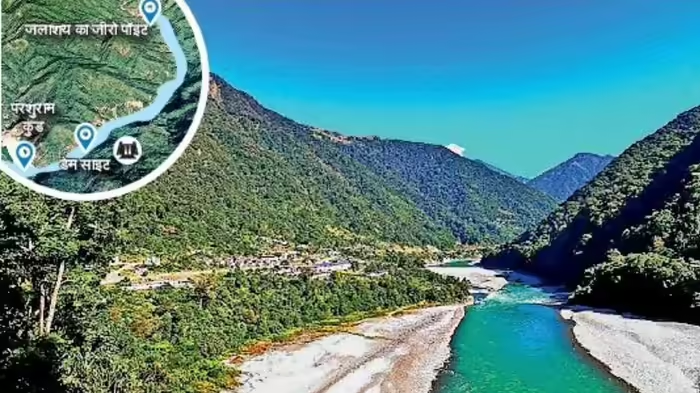
The Arunachal Pradesh government is promoting the 1,200 MW Lohit-II hydropower project on the Lohit River as environmentally friendly due to its run-of-river design. The project promises thousands of jobs and holds strategic importance given the state’s proximity to China. However, environmentalists and local communities warn that the development comes with severe ecological and social risks that could threaten the region’s delicate biodiversity and local livelihoods.
Development vs. Environment
A panel of experts under the Ministry of Environment has recommended environmental clearance for the project, located in Anjaw district and managed by THDC India Limited at a cost of ₹14,176 crore. It is expected to generate 485.3 crore units of electricity annually, contributing to India’s energy security and clean energy targets.
While the government highlights employment opportunities and strategic benefits, the Environmental Impact Assessment (EIA) has ignored critical issues, including the presence of the critically endangered White-bellied Heron (Ardea insignis), of which fewer than 60 individuals exist in India.
Potential Ecological Damage
The 128.5-meter-high concrete gravity dam will submerge 15–23 km of the river near Hawai village, disrupting the natural flow. Seasonal water retention of 15–20 hours could cause downstream droughts, while sudden water release during monsoons may trigger floods. Fish species like Tor tor and Tor putitora could lose breeding grounds, and the risk of landslides, glacial lake outburst floods (GLOFs), and earthquakes could increase.
The Ministry of Environment and Forests had already warned in 2011 about potential ecological destruction in the Lohit Basin, yet these warnings have been largely ignored. The project threatens to destroy nesting sites of the White-bellied Heron in Walong and Namdapha Tiger Reserves and could reduce fish availability, impact riverine habitats, and increase bird collisions with power lines.
Threat to Livelihoods and Local Communities
The project faces strong opposition from tribal communities in villages like Nukung, Mla, and Chengung. Nearly 1,500 people may be displaced, losing agricultural, fishing, and forest-based livelihoods. Local groups allege that the Social Impact Assessment (SIA) was non-transparent and that their objections were not recorded. Indigenous communities are fighting to preserve cultural identity while advocating for alternative renewable energy like wind power in the Tailung area.
Path Forward: Balancing Development and Conservation
Sustainable development can only be achieved by prioritizing basin-level studies, transparent EIAs, and genuine local consent. Proposed measures include:
- Basin-level cumulative impact assessment (CIA) before project approval.
- Special conservation programs for the White-bellied Heron, including artificial feeding zones and nest monitoring.
- Free, Prior, and Informed Consent (FPIC) from local gram sabhas.
- Land-based rehabilitation and cooperative fisheries for displaced communities.
- Allocating at least 30% project shares to local communities.
- Public disclosure of EIA reports with involvement of local experts and NGOs.
- Implementation of river zoning policies, including “no-dam zones” for tourism-based livelihoods.
If such measures are implemented, the Lohit-II project could provide clean energy while protecting the ecological and social fabric of Arunachal Pradesh, preserving public trust in development initiatives in the Northeast.
Discover more from SD NEWS agency
Subscribe to get the latest posts sent to your email.