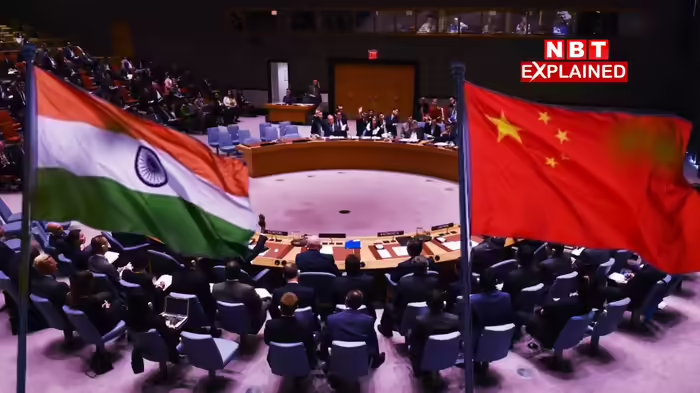
New Delhi: India has long sought a permanent seat in the United Nations Security Council (UNSC), but its efforts continue to face hurdles, with China once again refraining from explicitly endorsing India’s bid.
The latest development followed a meeting in Delhi between India’s Foreign Secretary Vikram Misri and China’s Executive Vice Foreign Minister Ma Zhaoxu, where both sides expressed satisfaction over progress in border peace and cooperation. The Indian Ministry of External Affairs stated that China acknowledged and respected India’s aspirations for a UNSC seat. However, China’s official statement made no reference to India’s membership, signaling a cautious stance.
China’s Stance
China, a permanent member of the UNSC, has historically blocked India’s bid for permanent membership, often alongside allies such as Pakistan and Turkey, who form part of the so-called “Coffee Club” opposing council reforms. Even after recent military de-escalations, China avoided explicitly supporting India, reflecting continued resistance despite recognizing India’s growing global role.
Previously, in 2014, during President Xi Jinping’s visit to India, China had acknowledged India’s significant contribution to the UN. Yet, in 2026, the UNSC membership issue remains unaddressed in official statements, despite India’s strong case based on its population size, nuclear capability, and global influence.
About the UNSC
The UNSC, headquartered in New York, is tasked with maintaining international peace and security, promoting friendly relations among nations, resolving international disputes, and coordinating global activities.
The council has 15 members:
- Permanent members (with veto power): USA, UK, Russia, France, China
- Non-permanent members: 10 countries elected for two-year terms by the UN General Assembly
Reforms to the UNSC require approval from two-thirds of UN member states, and India’s bid is strongly backed by the G4 nations—Brazil, India, Germany, and Japan—who advocate for increased permanent and non-permanent seats.
Obstacles from the Coffee Club
The Coffee Club, founded in 1995 and comprising 12 countries including Italy, Spain, San Marino, Pakistan, South Korea, Canada, Mexico, Argentina, Colombia, Costa Rica, and Turkey, has consistently opposed UNSC expansion, arguing it may dilute the council’s power. Pakistan and Turkey, in particular, have been vocal against India’s bid.
India’s Case
India’s claim for a permanent seat is considered highly compelling, given it is the second-most populous country, a nuclear power, and a major contributor to global governance and peacekeeping. Despite strong support from countries like the USA, France, UK, and Russia, China’s reluctance continues to pose a major hurdle in realizing India’s long-cherished goal.