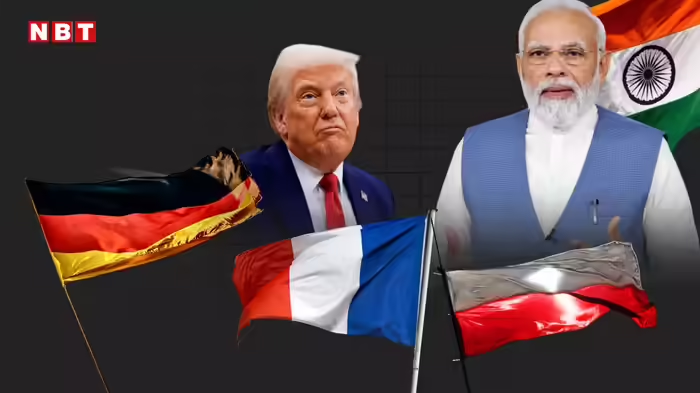
India’s engagement with Europe is entering a decisive phase, signalling a major shift in global geopolitics and trade diplomacy. As uncertainty continues to cloud India–US trade negotiations under former US President Donald Trump’s unpredictable “Make America Great Again” approach, New Delhi is steadily strengthening its strategic and economic ties with Europe—emerging as a credible alternative to Washington.
This month, India and the European Union (EU) are set to hold a high-level summit, where a long-pending India–EU Free Trade Agreement (FTA) is expected to gain fresh momentum. In the run-up to this summit, India has moved swiftly to deepen bilateral engagement with three of Europe’s most influential powers—Germany, France and Poland—effectively shaping what analysts are calling a new European diplomatic triangle.
High-Profile European Visits to India
The diplomatic push is marked by a series of high-level visits. German Chancellor Friedrich Merz has begun his first official visit to India, while Emmanuel Bonne, diplomatic adviser to French President Emmanuel Macron and France’s G20 Sherpa, is also in New Delhi. Soon after, Poland’s Foreign Minister Radosław Sikorski is scheduled to arrive.
Together, Germany, France and Poland account for nearly half of the EU’s total GDP, with Germany leading as the world’s third-largest economy—followed closely by India. Their coordinated engagement with New Delhi underlines Europe’s growing interest in India as a stable economic and strategic partner.
Trade, Technology and Strategic Cooperation
Germany’s outreach ahead of the India–EU FTA reflects Berlin’s intent to expand trade, investment and industrial cooperation with India. The partnership—now marking 25 years of strategic ties—is expected to grow across sectors such as technology, education, skill development, mobility and green energy.
France, already one of India’s closest strategic partners, has significantly strengthened cooperation in defence, aerospace and security. The visit of President Macron’s adviser ahead of the AI Impact Summit in February highlights Paris’s long-term commitment to deepening ties with India in emerging technologies.
Poland’s engagement is particularly significant. While Warsaw has in recent years shown growing proximity to Pakistan, Prime Minister Narendra Modi’s visit to Poland in 2024 and his meeting with Prime Minister Donald Tusk helped reset bilateral relations. Since then, both sides have focused on trade, investment, science, defence, security and people-to-people ties.
A Strategic Message to Washington
The timing of these visits—just days before the India–EU Summit on January 27—is being widely interpreted as a strong geopolitical signal. As US trade policy remains uncertain and often transactional, India’s closer alignment with Europe offers a clear counterweight to American unpredictability.
Foreign policy experts see this emerging European triangle as a direct response to Trump-era trade brinkmanship, demonstrating that India has viable and powerful alternatives in global economic partnerships.
Shifting Geopolitics, Stronger Foundations
India’s diplomatic engagement with Europe has been building steadily. External Affairs Minister S. Jaishankar’s recent visits to France and Luxembourg, along with India’s participation in the Weimar Triangle meeting—which includes France, Germany and Poland—have laid the groundwork for deeper cooperation.
Together, these efforts indicate that India–EU relations are now anchored on a solid strategic foundation, with Germany, France and Poland emerging as key pillars. This evolving partnership not only strengthens India’s global standing but also reshapes the balance of power in international trade and diplomacy.
As global geopolitics continues to shift, India’s European outreach sends a clear message: New Delhi is prepared to navigate uncertainty by forging strong, diversified alliances—making unilateral pressure tactics increasingly ineffective.
Discover more from SD NEWS agency
Subscribe to get the latest posts sent to your email.