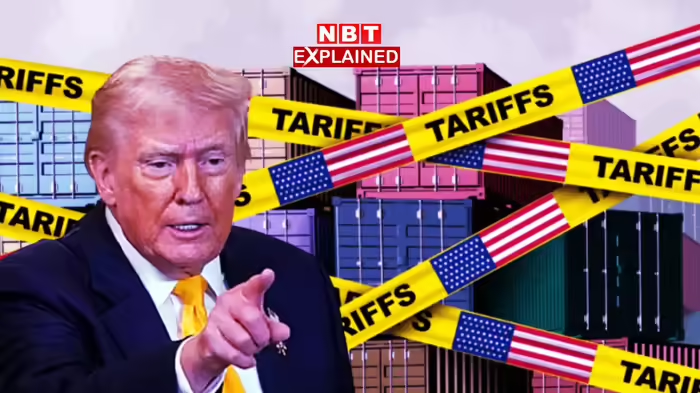
New Delhi: The U.S. Supreme Court’s recent ruling invalidating former President Donald Trump’s tariffs has provided some immediate relief to the global economy. However, experts caution that the decision may not change the overall scenario and that India, China, and other countries affected by the tariffs could still face significant challenges.
Supreme Court Ruling and Its Immediate Effect
The Supreme Court struck down Trump’s tariffs, which had been used as an economic weapon under the International Emergency Economic Powers Act (IEEPA). The decision affects tariffs applied under national emergency powers, which had generated over $175 billion to date. Experts say the ruling offers short-term relief but does not fundamentally alter the tariff regime.
Trump Imposes 10% Global Tariff
Soon after the ruling, Trump introduced a 10% global tariff for 150 days, keeping uncertainties alive in international trade. Analysts, including Vlass Fokman of the European Policy Centre (EPC), warn that global commerce may become even more unpredictable as countries assess the implications of U.S. tariff policies.
Impact on India and China
According to Global Trade Alert, the Supreme Court ruling reduces the average U.S. tariff that had been burdening trade from 15.4% to 8.3%. Countries like India, China, and Brazil, which had faced higher tariffs, will see significant percentage reductions, though tariffs will remain relatively high. Currently, India faces an 18% U.S. tariff on affected goods.
Bilateral Trade Deals Unaffected
Experts note that existing bilateral trade agreements will not be impacted by the Supreme Court’s decision. The Trump administration had already indicated it might pursue other legal measures to reapply tariffs, ensuring that some degree of protectionism remains in place.
China’s Response to Tariff-Induced Chaos
Fokman highlighted that China managed to mitigate disruption caused by Trump’s tariffs by recording a $1.2 trillion trade surplus in 2025, driven by accelerated exports to non-U.S. markets. This has allowed some countries to maintain existing bilateral agreements with the U.S. while adapting to the shifting trade environment.
Europe-U.S. Trade Relations
Meanwhile, research by Bruegel think tank’s Niklas Poitiers points to potential complications in EU-U.S. trade agreements, noting political tensions and the risk of Europe being forced to make concessions. The overall picture remains one of uncertainty and strategic recalibration in global trade.
In summary: While the Supreme Court ruling provides temporary relief, tariffs on India and other countries will continue, and global trade dynamics remain highly unpredictable, prompting nations to reassess their strategies in dealing with the U.S.
Discover more from SD NEWS agency
Subscribe to get the latest posts sent to your email.