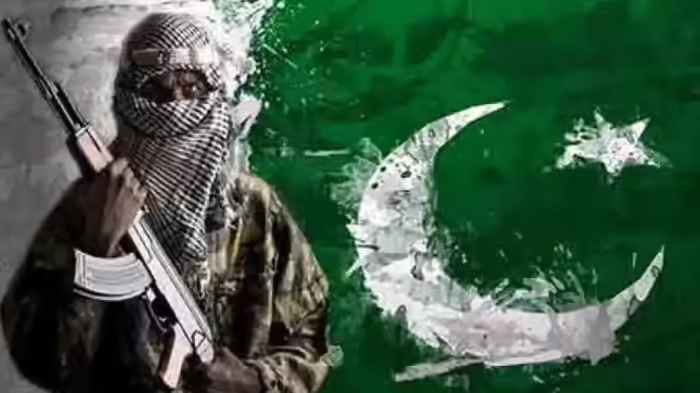
Pakistan’s long-standing use of terrorism as an instrument of state policy is no longer a hidden truth. Recent audio and video messages attributed to Jaish‑e‑Mohammed (JeM) chief Masood Azhar and his deputy Saifullah Kasuri have once again brought Pakistan’s terror ecosystem into sharp global focus, exposing the deep nexus between extremist groups, the Pakistani military, and the ISI.
In an audio message circulated widely by social media handles believed to be aligned with Pakistan’s intelligence establishment, Masood Azhar claimed that JeM has prepared thousands of suicide attackers ready to strike India. Earlier, Saifullah Kasuri appeared in a video boasting that he was invited to offer prayers at the funerals of Pakistani soldiers killed during “Operation Sindoor.” More disturbingly, Kasuri was seen addressing hundreds of children inside a school campus—clear evidence of systematic radicalisation under state patronage.
Institutional Support for Terror
The open circulation of these messages by ISI-linked accounts strongly suggests an institutional partnership between Pakistan’s army, its intelligence agencies, and terror outfits. Public speeches by globally designated terrorists, delivered without fear of reprisal, underline the freedom with which extremist leaders operate in Pakistan. This also signals a broader effort to indoctrinate a new generation into violent extremism, with the military establishment acting as a silent guarantor.
Psychological Warfare or Hollow Threat?
The intent behind these messages raises an important question: are they genuine threats or part of a psychological warfare campaign against India? Following Operation Sindoor, JeM’s terror infrastructure was severely damaged, with several key operatives—including members of Masood Azhar’s family—eliminated. Rebuilding such a network would be a formidable challenge.
Security experts therefore view Azhar’s claims as largely hollow—more an expression of desperation than real strength. Even Azhar’s very existence remains uncertain, making the authenticity of the audio itself questionable. Until forensic analysis of voice samples and metadata is completed, definitive conclusions remain premature.
Pakistan’s Proxy War Doctrine
After repeated military defeats against India until 1971, Pakistan shifted from direct confrontation to proxy warfare. Unable to win conventional wars, it began exporting terrorism by training and deploying so-called “mujahideen” into India. Religious organisations such as Markaz Dawa‑ul‑Irshad, Jamaat‑e‑Islami, Sipah‑e‑Sahaba, Lashkar‑e‑Taiba, and Jaish‑e‑Mohammed became key instruments of this strategy.
Under General Zia‑ul‑Haq, religious extremism was aggressively promoted as state policy, earning him the description of a “man in uniform with a cleric’s mindset.” Since then, terrorism has remained central to Pakistan’s national security doctrine.
Terror as a Tool of the State
In her book Guns and Yellow Roses, journalist Pamela Constable describes the extremist mindset fostered in Pakistan: a belief that dying in jihad against India guarantees a place in heaven. This ideology continues to fuel militant groups and explains why terrorism in Pakistan functions almost like an industry—sustained, protected, and ideologically justified.
Driven by Jealousy and Insecurity
Through proxy war, Pakistan seeks three strategic objectives. First, to slow India’s rise as a global power and a leading voice of the Global South by forcing it to divert resources toward internal security. Second, to wage psychological warfare, eroding public trust in institutions through fear and instability. Third, to internationalise the Kashmir issue by projecting terrorism as an indigenous “freedom struggle.”
At times, Pakistan finds encouragement—direct or indirect—from major powers such as China and the United States, reinforcing its belief that this strategy can continue with limited consequences.
Vigilance Is Essential
The recent JeM audio and video messages appear to be part of a broader attempt to revive a shattered terror network, boost morale among cadres, and reassert relevance. While many of these threats may be exaggerated, dismissing them outright would be a grave mistake.
Pakistan’s reliance on terrorism as a strategic asset remains unchanged. As long as its military and extremist groups operate as two sides of the same coin, regional peace will remain fragile. For India and the international community alike, sustained vigilance and accountability are the only viable responses.
Discover more from SD NEWS agency
Subscribe to get the latest posts sent to your email.