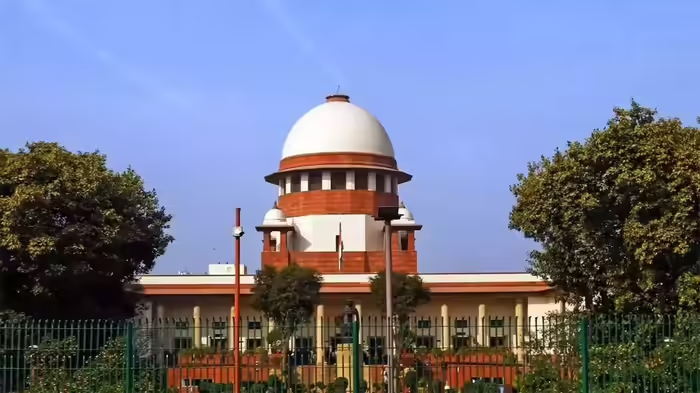
New Delhi: The Supreme Court of India has refused to grant relief to a government employee who concealed pending criminal cases while applying for a government job, overturning the Allahabad High Court’s earlier judgment. The apex court emphasized that sympathy cannot replace the law, and as a result, the individual will lose his government position.
The court noted that disclosing all relevant information is a fundamental condition for employment in government service. By hiding his criminal record, the applicant undermined the integrity of the recruitment process.
Apex Court’s Observations
A bench comprising Justices Sanjay Karol and N.K. Singh remarked during the hearing, “The law may be strict, but law is law.” The Supreme Court struck down the High Court’s decision, which had deemed the omission to be minor and not sufficient to cancel the appointment.
The court stated that providing complete and truthful information in a government application is not merely a formality—it is essential for fairness, transparency, and maintaining public trust. With hundreds or even thousands of candidates vying for a single position, proper scrutiny ensures equality and credibility in the selection process.
“When a candidate hides their criminal history, it weakens the process,” the court observed, “The appointing authorities cannot fully assess the suitability of such a candidate.”
Strict Action Needed in Such Cases
While the law recognizes that withholding information may not always be fatal depending on the nature and circumstances of the offense, intentional concealment constitutes serious fraud, especially if repeated. The court stressed that government services demand honesty and transparency, and authorities must act firmly in such cases.
Background of the Case
The employee in question had been appointed as an Assistant Review Officer. Later, it was discovered that he had two pending criminal cases, which he failed to disclose in his application. Following his dismissal, he approached the Allahabad High Court, which initially quashed his termination. The state government then appealed to the Supreme Court, which has now restored the dismissal.
The Supreme Court’s verdict reinforces the principle that no law or sympathy can override the strict requirements of public service, ensuring that integrity and fairness remain central to government employment.
Discover more from SD NEWS agency
Subscribe to get the latest posts sent to your email.