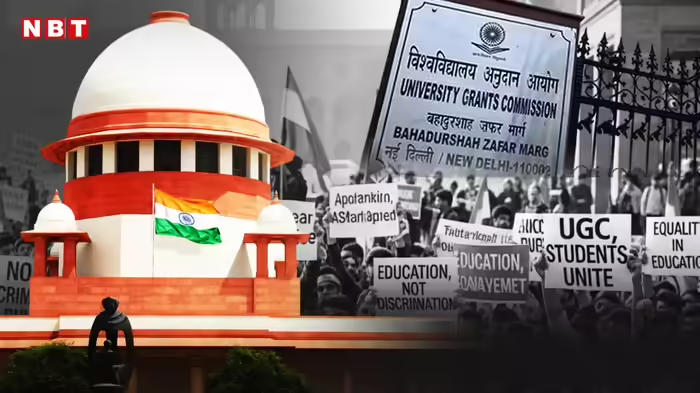
The Supreme Court on Thursday issued notices to the central government and the University Grants Commission (UGC) while staying the implementation of the UGC’s “Promotion of Equity Regulations 2026.” The top court expressed serious concerns about the rules, calling them vague and potentially prone to misuse, and suggested that they be reviewed by a committee of eminent jurists.
The regulations, notified on January 13, were framed to address caste-based discrimination in higher education institutions, following a 2019 public interest litigation filed by the mothers of Rohith Vemula and Payal Tadvi, who had allegedly faced caste discrimination on campuses. However, three petitions filed by individuals including Mrityunjay Tiwari, advocate Vineet Jindal, and Rahul Diwan challenged the new rules, claiming they could discriminate against the general category and violate the Constitution.
The Supreme Court has ordered that the 2012 UGC regulations remain in effect until the matter is fully resolved. The next hearing has been scheduled for March 19, 2026.
Here are five key takeaways from the Supreme Court proceedings:
- Vague Language, Potential Misuse
The bench, led by Chief Justice Suryakant and comprising Justice Joymalya Bagchi, noted that the 2026 regulations are ambiguous. “At first glance, the regulations appear unclear and carry a risk of misuse,” the Chief Justice remarked, suggesting a remodulation or review by legal experts. - Need for a Committee of Experts
The court proposed that an expert panel, including 2–3 jurists with an understanding of social values and societal challenges, review the regulations to ensure they do not adversely impact broader societal harmony. - Questions About Section 3(1)(c)
Petitioners highlighted that the definition of “caste-based discrimination” under Section 3(1)(c) covers only Scheduled Castes, Scheduled Tribes, and Other Backward Classes, excluding discrimination against general category students. The bench questioned the necessity of this provision when Section 3(1)(e) already defines discrimination broadly. Chief Justice Suryakant observed that this duplication could lead to unintended societal division. - Concerns Over Inclusivity and Campus Dynamics
The bench raised examples highlighting gaps in the regulations, such as harassment or ragging based on regional differences or senior-junior dynamics, which are not addressed under the current framework. Justice Bagchi emphasized that educational institutions should reflect India’s unity, cautioning against rules that may segregate students by caste or other categories. - Potential Societal Impact
The Chief Justice warned that the 2026 regulations could “divide society” and have far-reaching, dangerous consequences. The court also objected to remedial measures like separate hostels for different caste groups, urging a focus on integration rather than segregation.
The 2026 regulations were initially drafted in response to the Supreme Court’s 2019 call for a robust mechanism to prevent caste-based discrimination on campuses. The new rules replaced the 2012 regulations, but the court’s stay ensures that the older, more inclusive framework remains in effect until a thorough review is completed.
The Supreme Court’s intervention underscores the delicate balance between protecting marginalized communities and ensuring that anti-discrimination measures are equitable, clear, and do not inadvertently foster division.
Discover more from SD NEWS agency
Subscribe to get the latest posts sent to your email.