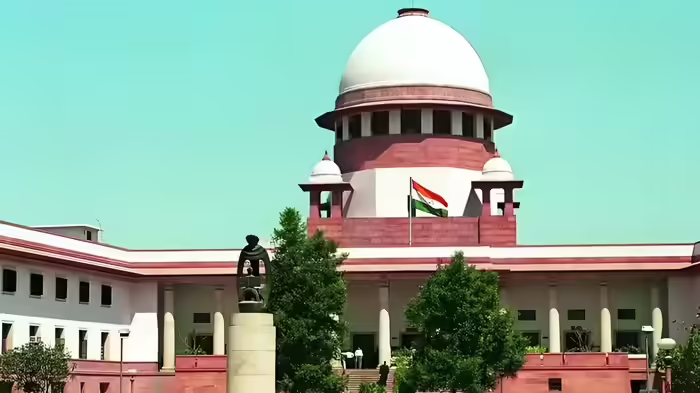
The Supreme Court of India was divided on the constitutional validity of Section 17A of the Prevention of Corruption Act, 1988, which requires prior approval before initiating investigations against public servants in corruption cases. The case arose from a public interest litigation (PIL) filed by the NGO, Center for Public Interest Litigation (CPIL), challenging the 2018 amendment to the Act.
Split Verdict on Section 17A
Justice B.V. Nagarathna held that Section 17A is unconstitutional and should be struck down. She argued that the requirement of prior sanction hinders investigations and gives corrupt officials an opportunity to evade accountability. Justice Nagarathna stated, “There should be no pre-approval requirement before commencing an inquiry. The prior sanction provision defeats the very objective of the Act, potentially protecting corrupt public servants instead of ensuring justice.”
On the other hand, Justice K.V. Vishwanathan upheld the constitutionality of Section 17A, emphasizing that prior approval is essential to protect honest officials from frivolous prosecutions. He suggested that sanctions should be granted by the Lokpal or State Lokayukta, ensuring that the law shields upright public servants while effectively punishing corrupt individuals.
Case Referred to Chief Justice
Given the divergent opinions, the matter has now been referred to Chief Justice of India D.Y. Suryakant. A larger bench will be constituted to hear the case afresh and deliver a final verdict on the contentious provision.
Senior advocates representing the NGO, including Prashant Bhushan, argued that Section 17A weakens the anti-corruption framework, noting that the government often delays or denies approvals, thereby undermining the law. Solicitor General Tushar Mehta represented the Union government in support of the provision.
The Supreme Court’s final decision on Section 17A is expected to have a far-reaching impact on corruption investigations and the functioning of public accountability mechanisms in India.
Discover more from SD NEWS agency
Subscribe to get the latest posts sent to your email.