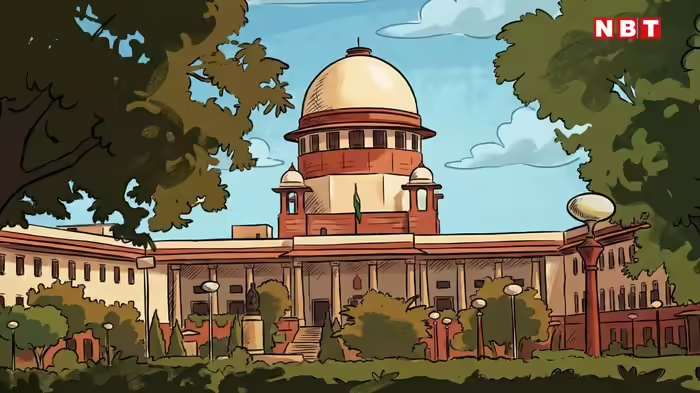
The Supreme Court on Tuesday delivered a split verdict on the constitutional validity of Section 17A of the Prevention of Corruption (PC) Act, which requires prior government approval before investigating public servants for offences committed while on duty. The two‑judge bench, comprising Justice B.V. Nagarathna and Justice K.V. Viswanathan, reached different conclusions, highlighting contrasting interpretations of the law.
Given the divided verdict, the matter has now been referred to the Chief Justice of India, CJI Suryakant, for consideration by an appropriate larger bench.
Justice Nagarathna Rules Section 17A Unconstitutional
Justice Nagarathna observed that Section 17A violates Article 14 (Right to Equality) of the Constitution. Drawing on the Supreme Court’s earlier ruling in Vineet Narayan vs Subramaniam Swamy, she said that requiring prior approval before initiating investigations defeats the purpose of the PC Act.
She criticised the provision as discriminatory, noting that it primarily applies to senior officials making policy decisions, effectively creating a “special class” without advancing the law’s anti‑corruption objectives. According to her, investigations can proceed immediately, and any procedural approvals can follow later, avoiding any policy paralysis.
Justice Nagarathna further stated that Section 17A protects corrupt officers rather than honest public servants, and therefore undermines the foundational objectives of anti-corruption legislation.
Justice Viswanathan Dissents, Upholds Constitutionality
Justice Viswanathan disagreed with Justice Nagarathna, warning that striking down Section 17A could have serious consequences. He argued that the possibility of misuse does not render a law unconstitutional. On the contrary, Section 17A provides protection to honest public servants, ensuring they are not harassed during their official duties.
He maintained that the law is constitutionally valid, as prior approval from competent authorities—including recommendations from the Lokpal or Lokayukta—does not exempt officers from scrutiny. Justice Viswanathan emphasized that India is governed by the rule of law, not individual discretion, and officials, including the Prime Minister and ministers, are themselves under the Lokpal’s jurisdiction.
According to Justice Viswanathan, Section 17A is neutral, applying to all public servants based on the actions they undertake in office rather than their rank, position, or seniority. Removing this safeguard could allow any allegation of corruption to trigger immediate police investigation, potentially undermining administrative efficiency and decision-making.
Key Exchange Between the Judges
During proceedings, Justice Viswanathan referenced a hypothetical scenario posed by Justice Nagarathna—what would happen if the Lokpal Act, 2013 were struck down—and asked whether the constitutional validity of Section 17A should similarly be evaluated in actual legal context, rather than on speculative assumptions.
Next Steps
The Supreme Court’s split verdict underscores the complexity of balancing anti-corruption measures with administrative safeguards. The matter will now be re-examined by a larger bench, which will carefully consider the arguments from both judges before delivering a conclusive ruling.
Discover more from SD NEWS agency
Subscribe to get the latest posts sent to your email.