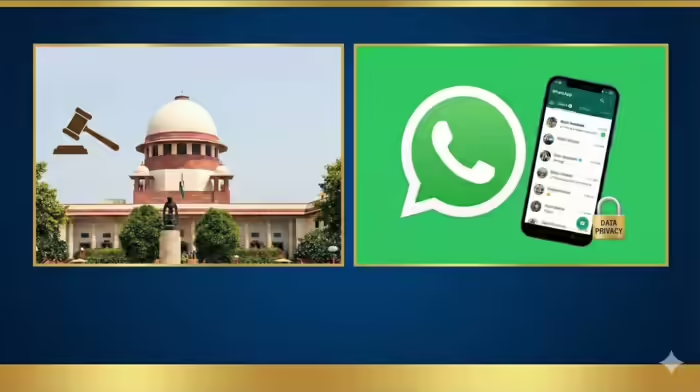
The Supreme Court of India has issued strong criticism against Meta Platforms Inc. and WhatsApp over their privacy policies, emphasizing that citizens’ right to privacy cannot be compromised. Chief Justice of India (CJI) Suryakant warned Meta that it cannot “play” with the nation’s privacy rights.
The bench, led by the CJI, was hearing appeals filed by Meta and WhatsApp challenging the National Company Law Appellate Tribunal’s (NCLAT) decision, which had upheld the ₹213.14 crore penalty imposed by the Competition Commission of India (CCI) on WhatsApp in relation to its 2021 privacy policy. The CCI had alleged that WhatsApp’s policy allowed the misuse of user data for advertising purposes, which was an abuse of its dominant position in India’s OTT messaging market.
During the hearing, the Supreme Court made it clear that Indian users’ private data cannot be exploited. The bench directed the Ministry of Electronics and Information Technology to be a party in these petitions. The CJI stated that the terms of the privacy policy were drafted in a manner so complex that an average user could not understand them, calling it “a civilized way of stealing personal information.” He emphasized that WhatsApp and Meta must provide a clear assurance that users’ personal data will not be misused, failing which the court will take strict action.
Senior advocates Mukul Rohatgi and Akhil Sibal, representing Meta and WhatsApp, informed the court that the penalty had been paid and that the matter related to the privacy policy was pending before the Constitution Bench. They also mentioned that under the Digital Personal Data Protection Act, 2023, the companies have until May 2027 to comply. However, Justice Bagchi pointed out that the Act is not yet in force and stressed the need to examine how WhatsApp rents user data and targets individuals for advertising.
The CJI shared a personal example, noting that even messages sent to a doctor about health issues often lead to targeted advertisements, raising concerns about user privacy. In response, the lawyers argued that WhatsApp messages are end-to-end encrypted and cannot be read by the platform.
The Supreme Court allowed Meta and WhatsApp to file a detailed affidavit outlining their practices and deferred further hearings to next Monday.
Background of the Case:
The dispute stems from a November 2024 CCI order scrutinizing WhatsApp’s 2021 privacy policy. The CCI found that WhatsApp, holding a dominant position in India’s OTT messaging market, imposed a “take it or leave it” framework, giving users no real choice while linking access to its messaging service with data sharing across Meta entities. This was deemed an abuse of dominance under the Competition Act, 2002, leading to a ₹213.14 crore penalty and corrective directions. Meta and WhatsApp challenged the order in NCLAT in January 2025. While NCLAT lifted the five-year ban on sharing advertising data, it upheld the monetary penalty, taking the matter to the Supreme Court.
Discover more from SD NEWS agency
Subscribe to get the latest posts sent to your email.