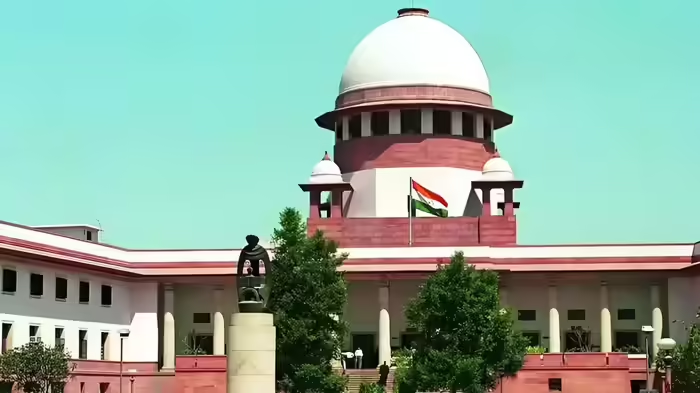
New Delhi, India: The Supreme Court delivered a landmark verdict on Friday, clarifying that statements made by a person before their death cannot be dismissed simply because some time has passed between giving the statement and their passing. The court also emphasized that such statements do not require being recorded in the presence of a magistrate to be considered valid.
A bench comprising Justices Sanjay Karol and N.K. Singh explained that the credibility of pre-death statements is not contingent on the statement being made immediately before death or under the fear of impending death. Moreover, the absence of a doctor’s certification regarding the mental fitness of the person giving the statement does not invalidate it.
Background of the Case
The case involved a woman who alleged that her husband had shot her because she gave birth to a daughter instead of a son. After her death, the husband challenged the admissibility of her pre-death statement, arguing that it should not be relied upon as it was neither recorded in the presence of a magistrate nor supported by medical certification of her mental soundness.
The Supreme Court rejected these claims, stating that such arguments were baseless. The bench cited the law, explaining that statements given to police officers under Section 161 of the CrPC relating to the circumstances of the person’s death are relevant and admissible under Section 32(1) of the Evidence Act, even if Section 162 of the CrPC prohibits statements to the police from being used as evidence in certain circumstances.
Action Based on Pre-Death Statement
The court accepted the appeal filed by the deceased woman’s parents, who alleged harassment by her in-laws and incitement by her husband leading to her death. Based on the woman’s pre-death statement and testimony from her nine-year-old daughter, the Supreme Court ordered action against her husband and in-laws, ensuring that justice is pursued.
This ruling reinforces the legal principle that pre-death statements, given in good faith and to competent authorities, hold evidentiary value, even in the absence of a magistrate or immediate proximity to death.
Discover more from SD NEWS agency
Subscribe to get the latest posts sent to your email.