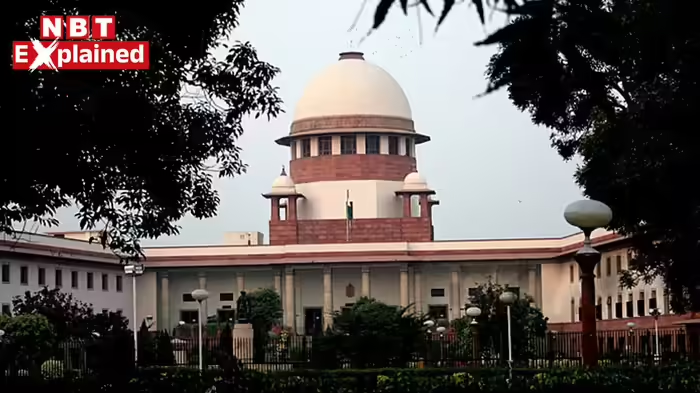
New Delhi: The Supreme Court on Monday declined to entertain a petition seeking directions to the Centre and State governments to ensure mandatory registration of all institutions imparting either religious or secular education to children below the age of 14. The Court observed that the matter primarily falls within the domain of the executive and advised the petitioner to approach the authorities concerned.
The petition was filed under Article 32 of the Constitution by advocate Ashwini Kumar Upadhyay, demanding that the government take appropriate steps to register every institution providing education—whether religious or non-religious—to children aged up to 14 years.
Bench Grants Liberty to Approach Executive Authorities
A bench comprising Justice Dipankar Datta and Justice S.C. Sharma permitted the petitioner to withdraw the plea, granting him liberty to make a proper representation before the concerned authorities.
The bench passed an order stating that the petition was dismissed as withdrawn, with freedom granted to the petitioner to approach the executive with a suitable representation.
Petitioner Raised Concerns of “Brainwashing” and National Security
During the hearing, the petition argued that children are the backbone of a nation’s future and, due to their tender age, are highly vulnerable to manipulation and indoctrination.
The plea expressed concern that children could be subjected to religious “brainwashing” through unregulated institutions, which could potentially have serious consequences for society and national security.
It claimed that the State has a heightened responsibility when dealing with minors and that all such institutions should operate under government monitoring and recognition.
Conflicting High Court Verdicts Highlighted
Senior advocate Gopal Sankaranarayanan, appearing for the petitioner, informed the Court that two High Courts—Allahabad and Kerala—had recently delivered contradictory judgments on the issue of recognition of educational institutions.
He stated that while the Allahabad High Court had reportedly allowed such institutions to function without formal recognition, the Kerala High Court took the opposite view and ordered closure of an unrecognised institution.
The counsel also referred to Supreme Court observations in the Anjuman-E-Ishtiaq-E-Taleem Trust case, which dealt with questions related to education imparted by minority institutions.
Supreme Court Questions Practical Meaning of Registration
Justice Dipankar Datta questioned the relevance and meaning of registration in such matters, remarking that in many States, systems already exist to regulate educational institutions.
He observed that in West Bengal, there is no separate concept of “registration” in the manner being sought, as madrasas are already regulated through the West Bengal Board of Madrasah Education.
The judge pointed out that every madrasa must be affiliated with the board, otherwise students cannot appear for classes and examinations—suggesting that regulation already exists in the State.
Court Emphasises Executive’s Role
The bench stressed that the executive should first examine the issue and determine how such a framework could be implemented across the country. Only after the government takes a view, the judiciary may consider the matter if required.
Fundamental Right to Education Highlighted
The petition also relied on Article 21A, which mandates free and compulsory education for children aged 6 to 14 years.
The petitioner argued that instead of being enrolled in formal education, many children are being sent to parallel religious education systems, which could deprive them of basic schooling and fundamental learning.
Demand for Clarification of Constitutional Provisions
The plea further sought a declaration that Article 30 should not be interpreted as permitting institutions to provide only religious education, and that “educational institutions of their choice” should mean secular or professional education, not religious instruction.
It also argued that religious educational institutions should fall under Article 26, rather than being covered under Article 30, claiming that the current interpretation is constitutionally incorrect.
Petition Withdrawn, Matter Left Open
After hearing the arguments, the Supreme Court declined to proceed further and allowed the petitioner to withdraw the plea, leaving the matter open for consideration by the executive authorities.
The Court’s stance reflects its view that such a policy-level decision should first be addressed through administrative and legislative mechanisms rather than judicial intervention.