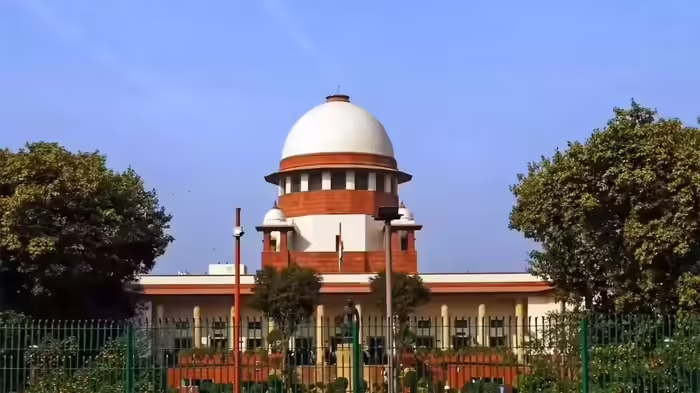
New Delhi: The Supreme Court on Friday delivered a landmark observation on freedom of speech, stating that while the right to speak is fundamental, it carries responsibilities and “cannot be misused.” The apex court refused pre-arrest bail to a 24-year-old Chartered Accountancy student from Bengaluru who had made objectionable posts about the Prime Minister and his mother on a parody social media account named “Jawaharlal Nehru Satire.”
The bench, comprising Chief Justice Surya Kant, Justice Joymalya Bagchi, and Justice Vipul M. Pancholi, advised the student to approach the Gujarat High Court for relief instead. The Supreme Court emphasized that individuals who misuse the right to free speech should not be granted discretionary relief by courts.
Background of the Case
The controversy arose after a complaint was lodged in Gujarat on November 7, alleging that the student had posted offensive content on social media targeting the Prime Minister and his mother, thereby harming their dignity and India’s image internationally. Following the complaint, an FIR was registered, and the Bengaluru police were involved in questioning the student. The social media platform involved subsequently blocked the account.
The student’s lawyer argued that the posts were not created by his client and that he had merely commented on a single post. The lawyer also claimed that the police had violated the student’s fundamental rights under Articles 14, 19, and 21, including illegal detention and threats of arrest. Despite cooperating with the investigation, the student sought protection from arrest.
Supreme Court Observations
The bench noted that the student showed no remorse for using insulting language against the Prime Minister’s mother. It reiterated that pre-arrest bail cannot be granted in cases where the right to freedom of speech is abused. “Individuals who misuse the freedom of speech should not expect discretionary relief from courts,” the judgment stated.
Key Takeaways
This case highlights the boundaries of free speech in India. While freedom of expression is a fundamental right, it must be exercised responsibly. Posts made through parody accounts or other social media platforms that are considered offensive or damaging to someone’s dignity may attract legal action. Although the Supreme Court refused direct relief, it left the door open for the student to present his case in a lower court, reinforcing the principle that the law does not tolerate abuse, even in digital spaces.
Discover more from SD NEWS agency
Subscribe to get the latest posts sent to your email.