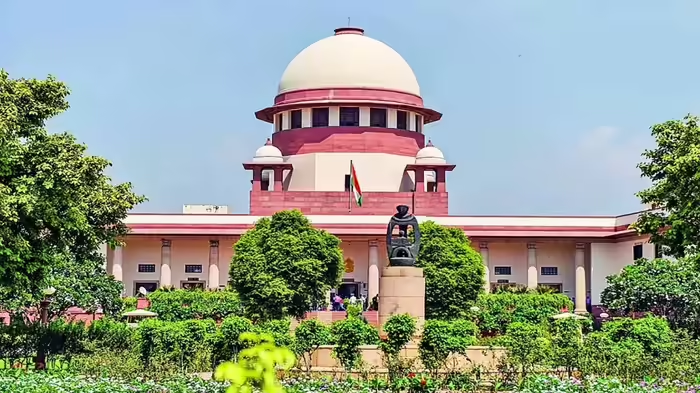
In a significant judgment, the Supreme Court of India has ruled that a widow daughter-in-law is entitled to maintenance from her deceased father-in-law’s property under the Hindu Adoptions and Maintenance Act, 1956 (HAMA). The court cited principles from the Manusmriti emphasizing the duty of family members to support each other.
Relief Granted by the Supreme Court
Earlier, there was confusion that a daughter-in-law could claim maintenance only if she became a widow during her father-in-law’s lifetime, not after his death. The Supreme Court has clarified that this distinction is unjust and baseless. Whether the widow loses her husband while her father-in-law is alive or after his demise, she is equally entitled to claim maintenance.
Bench Observation
The judgment, delivered by Justices Pankaj Mittal and S.V.N. Bhatti, highlighted Section 22 of the Hindu Adoptions and Maintenance Act, 1956, which mandates that the dependents of a deceased person must be maintained from their property. This legal obligation falls on the heirs of the deceased, and a widow daughter-in-law is explicitly recognized as a dependent under this provision.
The court clarified that if a son dies, it is the moral and legal responsibility of the father (the father-in-law) to ensure the widow daughter-in-law is provided for, especially if she cannot sustain herself from her own earnings. There is no provision in the Act that absolves a father-in-law of this responsibility, irrespective of whether the widowhood occurs before or after his death.
Manusmriti Reference
The Supreme Court invoked the Manusmriti, emphasizing that no mother, father, wife, or son should be left alone in society, and neglecting this duty should attract penal consequences. The court stressed that family members must act as a support system for one another, reinforcing both moral and legal obligations.
This landmark decision ensures that widow daughters-in-law receive financial security and social protection, aligning statutory law with age-old principles of familial responsibility.
Discover more from SD NEWS agency
Subscribe to get the latest posts sent to your email.