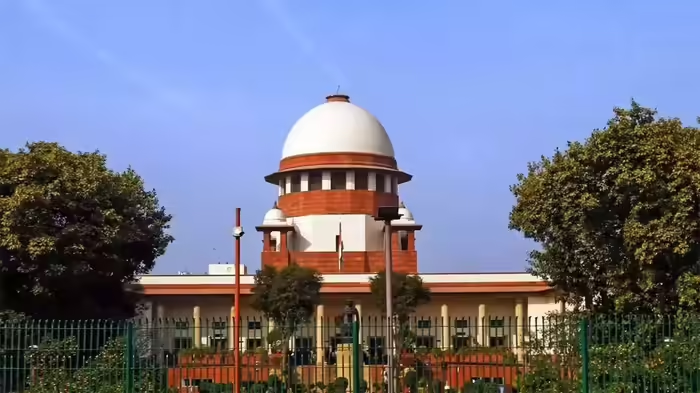
In a landmark ruling, the Supreme Court of India has directed the central and state governments to ensure that 25% of seats in private unaided, non-minority schools are reserved for children from economically and socially weaker sections (EWS), under the Right to Education (RTE) Act. The court emphasized that providing access to quality education for underprivileged children is a national mission essential for fostering social fraternity.
Equal Education for All
The bench, comprising Justice P.S. Narasimha and Justice A.S. Chandurkar, noted that the RTE Act guarantees equal education to all children irrespective of caste, class, gender, or economic status. Justice Narasimha highlighted that Section 12 of the Act reinforces constitutional principles of equality, liberty, and fraternity. The court stated that reserving 25% of seats in unaided neighborhood schools is not merely a welfare measure but a constitutional commitment to fraternity and to realizing a child’s right to development under Articles 21A and 39(f).
Citing the Kothari Commission Report, the court stressed the need for a common school system, where children from all sections of society receive equal education without discrimination.
Ensuring Integration and Dignity
Addressing concerns about how children from weaker backgrounds will integrate with wealthier peers, the court stated that this challenge can be overcome if teachers and schools use inclusive teaching methods that respect these children as learners, enhancing their self-esteem and ensuring equal status.
Implementation and Oversight
The Supreme Court directed authorities to formulate rules under Section 38 of the RTE Act detailing how EWS and disadvantaged children will be admitted to private schools. The National Commission for Protection of Child Rights (NCPCR), along with State Commissions (SCPCRs) and advisory councils, will assist in drafting these rules. States and Union Territories are required to submit compliance details to the court by 31 March 2026. The next hearing is scheduled for 6 April 2026.
Background of the Case
The petition arises from a case where children were denied admission in 2016 to a nearby private school for free, compulsory primary education despite available seats. The petitioner approached the Mumbai High Court, leading to the Supreme Court’s intervention to enforce the 25% quota for economically weaker sections under the RTE Act.
With this ruling, the Supreme Court has reinforced India’s commitment to inclusive education, ensuring that children from all economic backgrounds can study side by side in private schools, fulfilling both educational rights and the constitutional ideal of fraternity.
Discover more from SD NEWS agency
Subscribe to get the latest posts sent to your email.