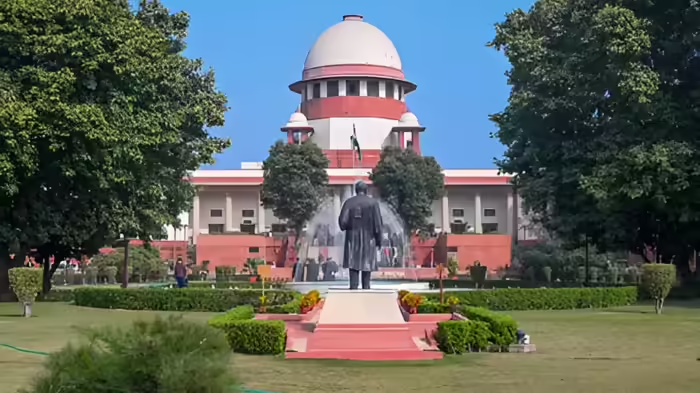
New Delhi: The Supreme Court on Wednesday indicated its willingness to hear a petition challenging the newly notified University Grants Commission (UGC) Regulations, 2026, which define caste-based discrimination in a limited manner. The matter was mentioned for urgent listing before a Bench headed by Chief Justice Suryakant.
During the hearing, the Chief Justice remarked that the court was already aware of the developments surrounding the regulations and asked the petitioner’s counsel to provide the case number and ensure that all procedural defects in the petition had been removed before seeking listing. “Give us the case number and make sure the defects are cured,” the Chief Justice said.
The petition, titled Rahul Diwan and Others vs Union of India (Diary No. 5477/2026), was mentioned orally for immediate hearing. The counsel appearing for the petitioners submitted that urgency was involved as certain provisions of the regulations were allegedly promoting discrimination against individuals belonging to the general category.
Allegations of Discriminatory Provisions
The petition challenges Regulation 3(c) of the UGC (Promotion of Equity in Higher Educational Institutions) Regulations, 2026. According to the petitioner, the definition of “caste-based discrimination” under the regulation is restrictive, as it confines protection only to members of Scheduled Castes (SCs), Scheduled Tribes (STs), and Other Backward Classes (OBCs).
It was argued that such a definition excludes individuals from other social categories who may also face caste-based discrimination, thereby denying them access to grievance redressal mechanisms and institutional safeguards.
UGC’s Rationale and Legal Challenge
The UGC framed the regulations to address issues of caste-based discrimination on university campuses. However, the petition contends that the protection offered under Regulation 3(c) is non-inclusive and fails to meet constitutional standards of equality.
Advocate Vineet Jindal, appearing for the petitioners, submitted that the provision, in its present form, deprives individuals outside the SC/ST/OBC categories of complaint redressal and institutional protection. He urged the court to restrain the authorities from implementing or acting upon the provision until it is reviewed.
Violation of Fundamental Rights Alleged
The petitioners have sought directions to redefine caste-based discrimination in a caste-neutral and constitutionally compliant manner, ensuring protection for all individuals facing discrimination, irrespective of their caste identity. They have also requested that Equal Opportunity Centres, Equity Helplines, and inquiry mechanisms established under the regulations function in a non-discriminatory manner until the provision is reconsidered.
The plea further alleges that exclusion from grievance redressal mechanisms on the basis of caste identity amounts to state-sponsored discrimination and violates Articles 14, 15(1), and 21 of the Constitution.
The petition seeks a declaration that Regulation 3(c) is arbitrary, discriminatory, and unconstitutional. Notably, the regulation has already been challenged in another petition filed before the Supreme Court on January 24.
Discover more from SD NEWS agency
Subscribe to get the latest posts sent to your email.