New Delhi:
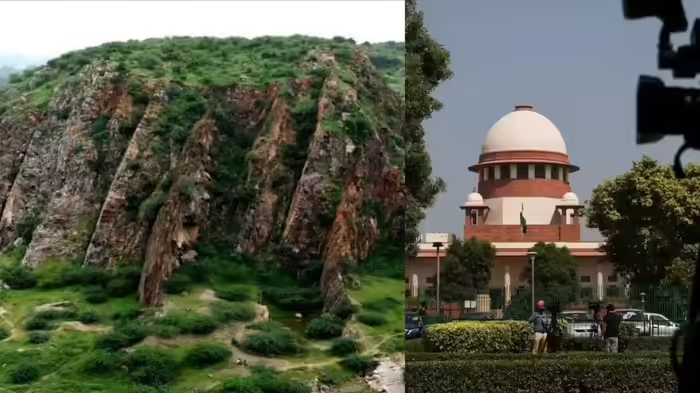
The controversy over mining in the Aravalli Hills has escalated as the Supreme Court of India has admitted a petition challenging the “100-meter criterion” used to define which hills qualify as part of the Aravalli range. The petition was filed by R.P. Balwan, a retired forest official from Haryana, raising concerns over the environmental impact of this new benchmark.
The 100-Meter Controversy
Earlier, a committee under the Ministry of Environment, Forest and Climate Change (MoEFCC) recommended that hills 100 meters or taller should be considered as Aravalli. On November 20, the Supreme Court adopted this definition as a standard for regulating mining activities. Balwan, however, has now challenged this approach, arguing that it undermines conservation efforts for this ancient and ecologically critical mountain range.
Stretching from Gujarat to Delhi, the Aravalli range acts as a natural barrier between the Thar Desert and the northern plains. Balwan cautions that excluding hills below 100 meters from legal protection could leave large swathes of the Aravalli vulnerable to unchecked mining. He also pointed out inconsistencies in the MoEFCC affidavit, particularly the rejection of the 3-degree slope survey method, which is considered more scientific.
Ministry and Court Response
Union Environment Minister Bhupender Yadav defended the 100-meter rule, stating that objections are based on misinterpretation. Meanwhile, the Supreme Court has sought responses from the central government, Haryana and Rajasthan state governments, and the MoEFCC regarding Balwan’s petition.
The case traces its legal roots to the 1996 TN Godavarman Thirumulpad vs Union of India judgment, which expanded the legal definition of forests beyond legally recognized forest land. Balwan argues that similar broad legal interpretation should apply to Aravalli, to prevent severe environmental consequences in Rajasthan, Haryana, Delhi, and across northwestern India.
Environmental Stakes and Mining Restrictions
The Supreme Court has previously imposed strict mining restrictions in Gurugram, Faridabad, and Nuh districts, emphasizing that unregulated mining causes irreversible environmental damage. The MoEFCC, in its affidavit, defended the 100-meter criterion, citing consensus on local relief and slope-based definitions, which Rajasthan uses to regulate Aravalli mining.
Balwan’s petition underscores that the 100-meter rule is more than a technicality; it could directly impact the ecological future of one of India’s most important mountain ranges. The Supreme Court’s ruling on this matter will have wide-ranging implications for forest conservation, environmental sustainability, and mining governance in northwestern India.
Discover more from SD NEWS agency
Subscribe to get the latest posts sent to your email.