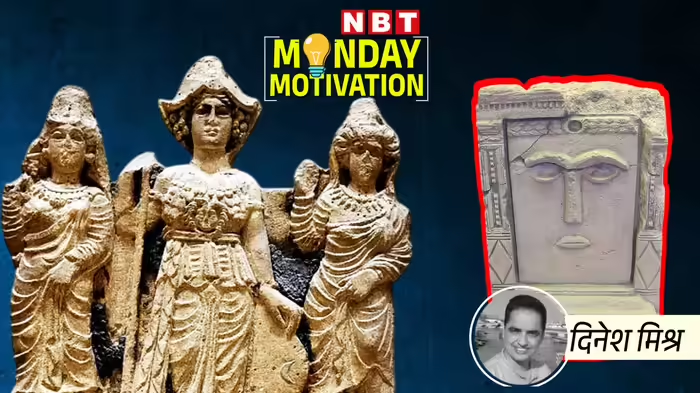
By Dinesh Mishra, New Delhi: January 2026 marks the 1,000th anniversary of Mahmud of Ghazni’s infamous attack on the historic Somnath Temple. Prime Minister Narendra Modi, in a recent op-ed, described Somnath as a symbol of India’s civilizational faith. Despite being subjected to one of the most tragic events in human history, the temple stands today in all its glory. Behind this iconic temple lies a fascinating story of the goddess Manat and her secret transfer from Arabia to Somnath.
Who Was Manat?
Manat, also pronounced as Manah, was a pre-Islamic Arabian goddess worshipped in the 6th–7th centuries, before the advent of Prophet Muhammad. She was one of the three principal goddesses of Mecca, alongside Al-Lat and Al-Uzza, and is considered the eldest and most ancient among them. The name Manat derives from the Arabic root mana, meaning “to measure,” or from mania, signifying “fate” or “destiny.” She was regarded as the goddess of fortune and destiny.
Was Mahmud’s Attack Linked to the Manat Idol?
According to M.J. Akbar in The Shade of Swords: Jihad and the Conflict between Islam and Christianity, Mahmud of Ghazni may have been motivated to attack Somnath because the idol of Manat was secretly moved there. Ghazni’s court poet, Farrukhi Sistani, claimed the assault targeted this hidden idol. He noted that the Persian name Su-Manat—the origin of the name Somnath—reflected the goddess Manat.
Later chroniclers, including Abu Saeed Gardezi, noted that while idols of other goddesses in Arabia were destroyed, the Manat idol was secretly relocated to Kathiwar (modern-day Gujarat) for safekeeping. Made of black stone and featureless, it could easily be mistaken for the Shiva Lingam at Somnath. Mahmud reportedly desecrated the idol, breaking it and taking parts as loot, exaggerating the temple’s wealth and significance in letters to the Caliph, earning him prestigious titles in return.
The Original Temple in Arabia
As per Abu Khalil and Shawqi (Atlas of the Prophet’s Biography, 2004), Manat’s main temple once stood along the Red Sea between Mecca and Medina, likely in Al-Mushallal. Her most devoted followers belonged to the Banu Aws and Banu Khazraj tribes.
Campaign to Destroy Manat’s Idol
The Sealed Nectar (Mubarakpuri & Saifur Rahman, 2020) notes that during a campaign led by Khalid ibn al-Walid, S’ad bin Zayd al-Ashhali, with 20 horsemen, was sent to Al-Mushallal to destroy Manat’s idol worshipped by polytheistic Arab tribes. Legends describe the idol as a black female figure, naked with disheveled hair, wailing and beating her chest. S’ad reportedly destroyed the idol, broke the shrine, and returned successfully.
Who Was Entrusted with the Idol’s Destruction?
Historical sources differ. Some suggest Ali was assigned the task, while Sir William Muir cites evidence pointing to S’ad. The accounts highlight that pre-Islamic devotees of Manat were targeted, emphasizing the strategic and symbolic nature of the attack.
Rebuilding of Somnath Temple
Due to its immense wealth and religious significance, Somnath has been destroyed and rebuilt multiple times in history. The modern temple reconstruction began post-independence under Sardar Vallabhbhai Patel, and on 1 December 1955, it was consecrated to the nation by President Rajendra Prasad.
The story of Somnath Temple and the hidden Manat idol stands as a testament to India’s enduring heritage and faith, surviving a millennium of invasions and still inspiring awe and devotion today.
Discover more from SD NEWS agency
Subscribe to get the latest posts sent to your email.