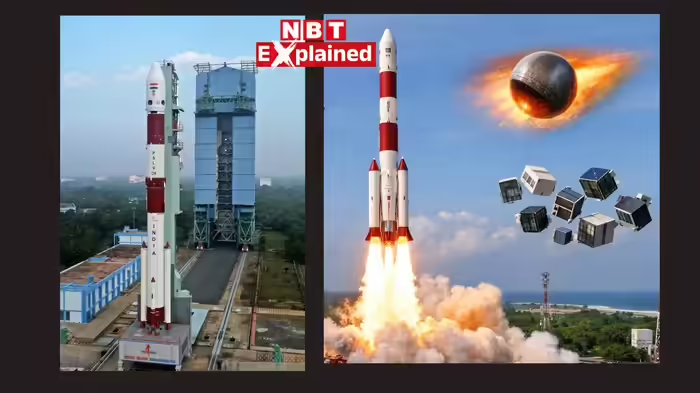
India narrowly missed creating a new chapter in its space and strategic history on January 12, when the Indian Space Research Organisation (ISRO) failed to complete the PSLV-C62 mission as planned. Although the launch vehicle lifted off from the Satish Dhawan Space Centre, Sriharikota—marking ISRO’s first orbital launch attempt of 2026—the rocket deviated from its intended trajectory, preventing the successful deployment of the highly strategic EOS-N1 satellite, code-named “Anvesha.”
The aborted mission triggered ripples far beyond India’s borders. According to strategic analysts, the very prospect of Anvesha entering orbit had set off “alarm bells” across the China, Pakistan, and Bangladesh frontiers, given the satellite’s advanced surveillance and reconnaissance capabilities.
What Is EOS-N1 ‘Anvesha’?
EOS-N1 is a hyperspectral Earth observation satellite developed by the Defence Research and Development Organisation (DRDO) and scheduled for launch aboard ISRO’s trusted Polar Satellite Launch Vehicle (PSLV). Unlike conventional remote-sensing satellites, Anvesha was designed with a clear defence and strategic focus.
Former ISRO scientist Dr. Vinod Kumar Srivastava explains that Anvesha represents a new class of satellites meant for high-precision monitoring of land, infrastructure, and military activity. Its hyperspectral sensors can detect hundreds of narrow spectral bands, allowing it to distinguish between metals, vehicles, vegetation, soil types, and even concealed objects based on how they reflect light.
Why Neighbouring Countries Were Concerned
Strategically, Anvesha was expected to provide India with near real-time, high-resolution imagery of sensitive regions. This capability would have significantly strengthened India’s ability to:
- Track troop movements and military build-ups
- Detect new roads, construction, or infrastructure changes near borders
- Monitor environmental changes that may indicate covert activity
- Support rapid decision-making during crises or conflicts
Experts say such capabilities would have enhanced surveillance along the China, Pakistan, and Bangladesh borders, giving India a decisive intelligence edge—hence the unease among neighbouring countries.
Multiple Satellites on Board
In addition to Anvesha, the PSLV-C62 mission was also carrying 15 smaller satellites, including payloads from Mauritius, Spain, and European demonstration missions. A successful launch would have further cemented India’s growing dominance in the global commercial satellite launch market, reinforcing its reputation as a reliable and cost-effective space partner.
Setback for ISRO’s Otherwise Strong Record
The PSLV family boasts a success rate of around 94 percent, making it one of the most reliable launch vehicles in the world. However, recent setbacks have raised concerns. In May 2025, the PSLV-C61 mission failed after a pressure drop in the third stage caused the loss of the EOS-09 radar imaging satellite.
With PSLV-C62 also falling short, questions are being raised about potential nozzle control failures and casing integrity issues in the solid-fuel third stage, despite multiple reviews by ISRO’s top technical bodies.
Impact on Future Missions
Parliamentary records and expert assessments suggest that the loss of these satellites could have implications for flagship missions such as Gaganyaan (India’s human spaceflight program) and Chandrayaan, as they rely on the same ecosystem of launch reliability, quality control, and mission confidence.
More Than a Failed Launch
While ISRO has stated that it is analysing mission data to identify the exact cause of the anomaly, analysts agree on one point: even in failure, the PSLV-C62 mission revealed how far India’s space and defence capabilities have advanced.
The fact that a single satellite launch attempt could unsettle strategic calculations across multiple borders underscores the growing role of space-based intelligence in modern geopolitics. Anvesha may not have reached orbit this time—but its very design has already made its impact felt.
Discover more from SD NEWS agency
Subscribe to get the latest posts sent to your email.