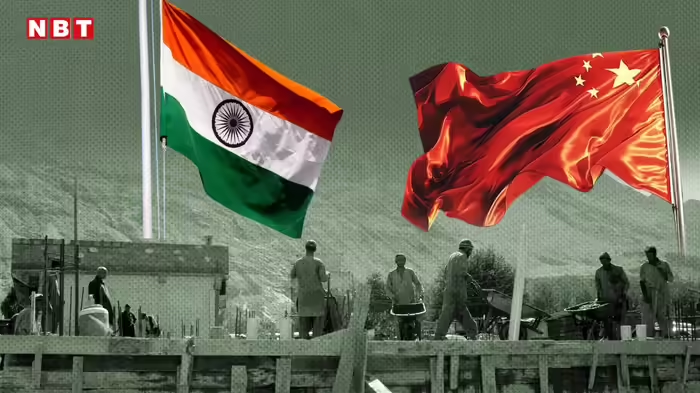
New Delhi: Tensions between India and China are escalating over the Shaksgam Valley in Ladakh. India maintains that the valley is an integral part of its territory, currently under illegal Chinese control, while China has increasingly asserted claims over the area.
China’s Renewed Claims
On Tuesday, China reiterated its claim on Shaksgam Valley and defended its ongoing infrastructure projects, citing a 1960s border agreement with Pakistan. Beijing asserted that its construction activities fall within “Chinese territory” and are therefore legitimate. India, however, has consistently objected to such developments under the China-Pakistan Economic Corridor (CPEC), emphasizing that any construction in this region violates Indian sovereignty.
Historical Context of the Dispute
Shaksgam Valley lies in the far northern reaches of Ladakh, beyond the Karakoram Range, close to Gilgit-Baltistan (Pakistan-administered Kashmir) and the Siachen-Aksai Chin area. China currently controls the region, treating it as part of Xinjiang. India asserts that it historically belonged to the princely state of Jammu and Kashmir, which legally merged with India in 1947. Following Pakistan’s illegal occupation in 1947–48, it handed over the valley to China in 1963 through a border agreement—a deal India has never recognized.
Indian officials, including MEA spokesperson Randeep Gaiwal, emphasize that the 1963 China-Pakistan Agreement explicitly noted that the boundary could be reconsidered once the Kashmir dispute was resolved, reinforcing India’s stance that the deal was never a final settlement.
Strategic Importance of Shaksgam Valley
The valley’s proximity to the Karakoram Pass and Siachen Glacier makes it highly strategic. Chinese infrastructure projects here, such as roads and basic facilities, could enhance its mobility and surveillance capabilities in the region, posing a significant national security challenge for India.
China’s Construction Activities
Reports indicate that China has built nearly 75 kilometers of all-weather road, approximately 10 meters wide, bringing it within 50 kilometers of India’s Siachen Glacier—India’s northernmost military outpost. This development has raised concerns that Shaksgam could become a flashpoint, potentially sparking a confrontation similar to the Galwan Valley clashes of 2020.
Pakistan’s Role
Pakistan’s historical cession of the valley to China complicates the situation. Although it controls adjacent regions, India maintains that Pakistan cannot transfer territory that originally belonged to the Jammu and Kashmir princely state. China’s legal claims based on Pakistan’s previous actions are therefore not recognized by India, keeping the valley at the center of a sensitive geopolitical dispute.
With Shaksgam Valley’s strategic and geopolitical significance, India will likely continue diplomatic and military vigilance to safeguard its territorial claims while monitoring Chinese infrastructure expansion in the region.
Discover more from SD NEWS agency
Subscribe to get the latest posts sent to your email.