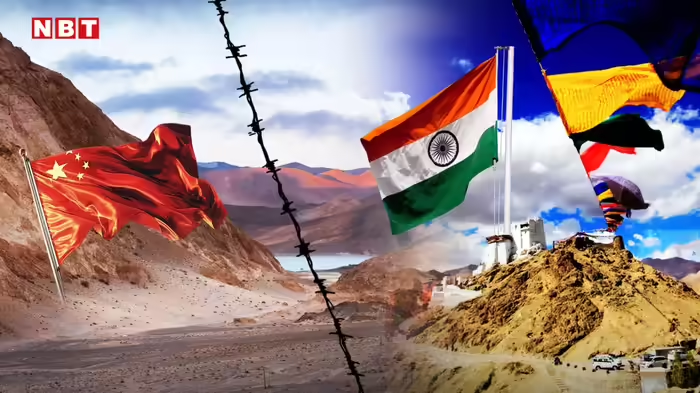
New Delhi: The unfolding situation in the Shaksgam Valley is a stark reminder of the historical deception India faces from China, enabled by Pakistan. The valley, legally part of India, has been under illegal Chinese control, following an arrangement that Pakistan had no right to make. Experts describe this “gift” from Pakistan as a festering wound in India’s northern frontier.
The 1963 ‘Illegal Gift’
In 1963, Pakistan signed a border agreement with China, now referred to as the China-Pakistan Boundary Agreement, handing over control of the Shaksgam Valley. However, India never recognized this move. The valley had been illegally occupied by Pakistan after 1948, yet the 1963 deal attempted to transfer sovereignty to China—despite Pakistan having no legal claim. India maintains that Shaksgam Valley is part of the former princely state of Jammu & Kashmir, now in the Union Territory of Ladakh, making the Chinese claim entirely unlawful.
Geopolitical Significance
The Shaksgam Valley is located in the Karakoram range, at an altitude of nearly 20,000 feet, north of Pakistan-occupied Gilgit-Baltistan and adjacent to China’s Xinjiang region. To the east lies the strategically vital Siachen Glacier, further underscoring the valley’s military and strategic importance.
China’s Expansionist Moves
China claims the valley under the 1963 agreement, arguing that building infrastructure is legitimate. However, India rejects this justification. The illegal nature of the transfer is reinforced by Article 6 of the China-Pakistan boundary treaty, which states that once the Kashmir dispute is resolved between India and Pakistan, the boundary must be re-negotiated with China, effectively nullifying any unilateral claims.
Despite this, China began constructing the Karakoram Highway in the 1970s and has since intensified its infrastructure and military presence, asserting a claim even while knowing Pakistan had no lawful rights to the territory. India regards the valley as an integral part of its territory, much like the rest of Jammu & Kashmir, including areas under Pakistan-occupied control.
India’s Firm Stand
Indian Army Chief General Upendra Dwivedi has made it clear that India does not accept any activities or claims by China in Shaksgam Valley. Regarding the China-Pakistan Economic Corridor, he emphasized, “We view it as illegal and will not recognize any developments undertaken by these two countries in this region.”
The Shaksgam Valley remains a sensitive and strategic flashpoint, with historical, legal, and geopolitical dimensions that continue to challenge India’s security calculus.