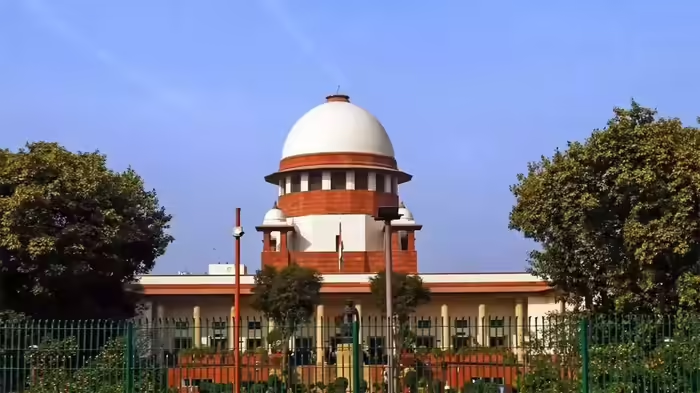
New Delhi: The Supreme Court has delivered a significant ruling on financial bankruptcy, clarifying that Resident Welfare Associations (RWAs) or any housing societies cannot intervene when a bank or financial institution initiates insolvency proceedings against a real estate developer. The Court emphasized that such matters fall strictly between the creditor and the debtor.
Bench Observations
A bench comprising Justices J.B. Pardiwala and R. Mahadevan noted during the hearing that when a company is subjected to insolvency proceedings under Section 7 of the Insolvency and Bankruptcy Code (IBC), the matter is exclusively between the lender and the borrower. Consequently, third-party organizations like RWAs or housing societies have no right to participate, either at the initial hearing or during appeals.
Claiming Creditor Status
The Court clarified that while homebuyers may qualify as financial creditors under the IBC, this status does not extend to RWAs or associations unless they themselves are debtors or are legally recognized as authorized representatives of the buyers. “A society is a separate legal entity distinct from its members. Unless it has provided its own funds or holds any financial debt, it cannot claim the status of a financial creditor,” the Court observed.
Preventing Misuse of Law
The bench also warned that allowing RWAs to intervene at the outset could expand the scope of the law unnecessarily, creating additional legal layers that developers might exploit to delay proceedings under the guise of protecting collective interests. Under Section 7, proceedings remain individual until the insolvency process is formally initiated, after which homebuyers can be represented collectively through an authorized representative.
Protecting Homebuyers’ Interests
While this ruling limits direct RWA intervention, the Supreme Court emphasized that the interests of homebuyers are fully protected under the IBC. To ensure transparency in future real estate insolvency cases, the Court issued several guidelines, including:
- Providing complete details of all allottees in the information memorandum.
- Recording written reasons when possession cannot be delivered.
- Presenting concrete, reasoned justification for recommendations on liquidation.
Case Background
The verdict stems from the Ahmedabad-based residential-commercial project, ‘Takshashila Elegna.’ The developer had borrowed approximately ₹70 crore from ECL Finance Limited. Following defaults, the loan was transferred to Edelweiss Asset Reconstruction Company Limited (EARCL), which initiated proceedings under Section 7 of the IBC. After the National Company Law Tribunal (NCLT) dismissed the petition, the National Company Law Appellate Tribunal (NCLAT) ordered the commencement of the Corporate Insolvency Resolution Process (CIRP), a decision upheld by the Supreme Court.
Discover more from SD NEWS agency
Subscribe to get the latest posts sent to your email.