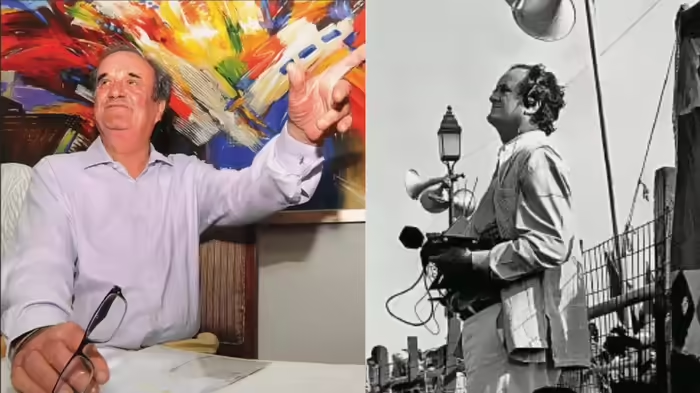
Mark Tully, the former BBC correspondent celebrated for his fearless and impartial reporting during India’s Emergency, has passed away at the age of 90. His reporting earned him respect across India, and during the Emergency, his uncompromising coverage led to his expulsion from the country. Tully also narrowly escaped lynching during the Babri Masjid demolition, making him one of the few foreign journalists whose name remains widely recognized in India.
Tully had been unwell for the past two years and was hospitalized last week. Serving as the BBC’s Chief of Bureau in India for 22 years, he covered a wide range of topics including the India-Pakistan wars, sati practices, Operation Blue Star, caste issues, Maoist insurgencies, and wildlife conservation. His reporting style was both empathetic and rigorous, engaging directly with people and listening attentively to their stories. Being fluent in Hindi allowed him to connect with sources in ways few foreign journalists could. Tully firmly believed that he was not the story; rather, he was a medium to deliver the news impartially and fearlessly.
In recognition of his contributions, Tully was knighted in 2002 and awarded the Padma Bhushan in 2005. Under his leadership, BBC became a trusted source of news in India, with Tully emerging as its most reliable voice. It is said that former Prime Minister Rajiv Gandhi first learned of his mother Indira Gandhi’s assassination through a BBC report.
Tully traveled extensively across South Asia, reporting on historic events including the execution of Zulfikar Ali Bhutto, the creation of Bangladesh, and the Soviet invasion of Afghanistan. Former colleague Qurban Ali recalls that Tully’s reports were always objective, often drawing criticism from both Pakistan and Bangladesh. During the Babri Masjid demolition on December 6, 1992, Tully and Ali were cornered by armed mobs, with Tully’s life narrowly spared thanks to the intervention of a local priest and journalist.
Early Life and Career
Born in 1935 in a well-to-do British family in Calcutta, Tully had limited early exposure to India. He received his schooling in Darjeeling before being sent to England at the age of ten. After studying at a public school and then Cambridge, he briefly trained for the priesthood twice before finding his calling in journalism. Tully arrived in Delhi in 1965 as an administrative assistant and made his mark as a reporter during the 1971 India-Pakistan war.
Reporting on Punjab and Operation Blue Star
Tully extensively covered Punjab in the 1980s, chronicling the rise of militancy. In his book Amritsar: Mrs. Gandhi’s Last Battle, he provided an eyewitness account of Operation Blue Star and analyzed the underlying causes of the insurgency. Co-author Jacob recalls Tully’s courage and relentless pursuit of the truth, always seeking to understand not just the “what” but the “why” behind events.
In his book Non-Stop India, Tully described the challenges of reporting for British audiences while also catering to Indian viewers, particularly in Hindi. Reflecting on the Emergency, he recounted how his editor once reprimanded him for covering the arrests of opposition leaders in 1975, to which he replied, “The Indian audience has certainly heard of them, and my report was for them.”
Later Career and Legacy
Tully resigned from the BBC in 1994, frustrated with the organization’s growing corporatization and detachment from its foundational journalistic principles. Even after retirement, he continued to engage with India through television series, books, and his deep interest in Hindu philosophy.
Prime Minister Narendra Modi, paying tribute to Tully, called him “a towering voice of journalism whose connection to India and its people was evident in his work.” Tully lived in Delhi’s posh Nizamuddin West area with his partner, renowned translator Gillian Wright.
Mark Tully’s life and career remain a testament to fearless, principled journalism and a deep respect for the stories and people he covered.
Discover more from SD NEWS agency
Subscribe to get the latest posts sent to your email.