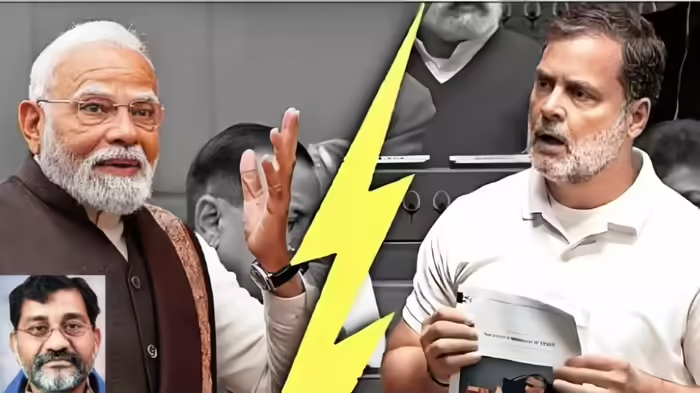
Since the Modi government came to power, political tensions have escalated, particularly from 2016-17 onwards. Instances of throwing papers towards the Speaker’s podium in the Lok Sabha and Rajya Sabha, standing on tables to mimic leaders, and other behaviors contrary to parliamentary traditions have been witnessed.
Rahul Gandhi vs PM Modi
The level of confrontation at the highest political echelons is worrying. It is unusual for Prime Minister Narendra Modi to remain silent during the Lok Sabha’s discussion on the President’s Address, but this has occurred recently.
Ruling Party’s Allegations
Lok Sabha Speaker Om Birla stated that he had requested the Prime Minister not to attend the House, citing concerns over potential unexpected incidents. However, the opposition contested this. According to the ruling party, Congress had planned to create a human blockade around the Prime Minister’s seat using 7-8 female MPs. Congress reportedly declared that if the opposition leader Rahul Gandhi was not allowed to speak, the Prime Minister would also not be allowed to speak. While the Prime Minister addressed the Rajya Sabha, the Congress remains firm on its stance in the Lok Sabha.
Parliamentary Disruptions Continue
Opposition members have disrupted the Prime Minister’s speech, staged walkouts, and created commotion on the House floor, causing parliamentary proceedings to be hindered. The country has witnessed such scenes before. For instance, on 24 June 1989, during the Bofors controversy, 106 of 110 opposition MPs in the Lok Sabha resigned. While campaigns demanded then-Prime Minister Rajiv Gandhi’s resignation, the boundaries of the House were not violated.
Historical Context
Disruptions also occurred during the UPA government, such as during the Commonwealth Games and 2G spectrum scandals. In 2014, when the Andhra Pradesh bifurcation bill was to be passed, similar challenges arose. On 14 February 2014, during the Lok Sabha proceedings, the broadcast on Lok Sabha TV had to be stopped due to disruptions. On 20 February 2014, the Rajya Sabha doors were shut and marshals summoned to pass the bill. Even during PM Manmohan Singh’s speech, papers were torn by MPs like Suvendu Roy of the Trinamool Congress. However, the present situation is more intense.
Rahul Gandhi’s Agenda
Since the Modi government came to power, from 2016-17 onwards, disruptions in the Lok Sabha and Rajya Sabha have worsened. Actions like throwing papers, standing on tables, and mimicking leaders go against parliamentary tradition. From the very first day, opposition leader Rahul Gandhi has followed a determined personal agenda, paying little attention to the House’s formal proceedings or topics.
Military Matters and Constitutional Concerns
Criticism of the government is expected on several issues, including the President’s Address. However, Rahul Gandhi’s focus has been on topics like the unpublished book of former Army Chief Manoj Naravane, which the Speaker had regulated. Gandhi used an article in a magazine as a basis, although it did not indicate any government inaction post the 2020 Galwan clash with China. Historically, incidents at the border with China, post-1962, occurred in 1967, with no other firing reported.
Rahul Gandhi, whose party holds the second-largest number of MPs after BJP, is expected to maintain decorum. In the last general election, the opposition leveraged misleading fears about the Constitution and reservations, gaining some political advantage. Moving forward, Congress may continue this strategy. Gandhi has already appealed to protect India’s Constitution and democracy, criticizing biased conduct in both Houses.
Current Situation Remains Unstable
The Election Commission is being portrayed as a BJP agent. The Modi government’s key strength lies in defense and national security. Is the opposition’s strategy to challenge this strength and portray it as false? Relations between the ruling party and opposition remain tense, with no immediate prospects for reconciliation. This state of politics is not healthy and should not reach a point of no return.
Discover more from SD NEWS agency
Subscribe to get the latest posts sent to your email.