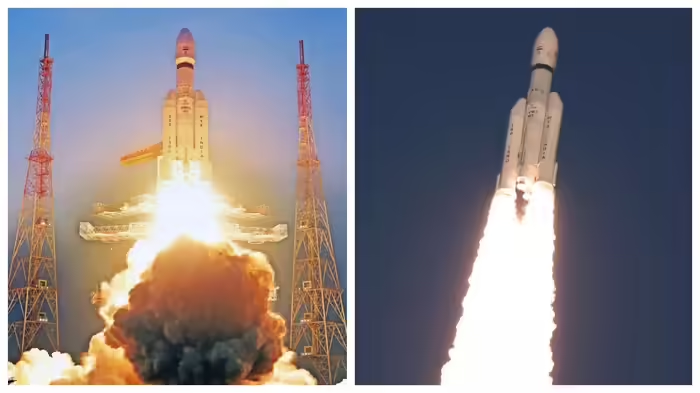
New Delhi: The Indian Space Research Organisation’s (ISRO) PSLV-C62 mission ended in failure on Monday, as a technical glitch in the rocket’s third stage prevented the successful deployment of 16 satellites. This marks the second consecutive setback for PSLV within nine months, raising questions about the launch vehicle’s reliability.
The mission, which carried satellites critical for strategic, diplomatic, and commercial purposes, suffered a failure just minutes after liftoff when the third stage experienced an anomaly. The primary payload, DRDO’s EOS-N1 (Anvesha), equipped with a hyperspectral imaging system, was intended to enhance India’s military capabilities in space.
Third-Stage Anomaly Confirmed
ISRO Chairman V. Narayanan explained that the rocket performed flawlessly up to the third stage, but a minor deviation in flight occurred at the end of the stage, preventing the mission from progressing. “Our scientific team is analyzing data from all ground stations to determine the exact cause,” he said.
The PSLV is a four-stage rocket, with alternating solid and liquid fuel stages. While performance was nominal through the third stage, a sudden disturbance in trajectory led to mission failure. Detailed investigations are ongoing before further updates are provided.
International and Startup Satellites Affected
The mission carried satellites from Nepal, the UK, Brazil, Thailand, and Spain, along with payloads from Indian startups demonstrating advanced technologies such as AI-based on-orbit processing, store-and-forward communication systems, radiation measurement, agricultural data collection, and a re-entry capsule to test post-deorbit operations.
One notable payload, AyulSAT, was designed for on-orbit refueling, a capability currently possessed only by China. AyulSAT was to act as a target satellite for OrbitAID’s chaser satellite six months later, bringing India closer to operational on-orbit refueling. OrbitAID founder and CEO Sakthikumar R. told The Times of India, “We now have to launch both the target and chaser satellites together, and we hope to achieve this by the end of the year.”
Pattern of Recent Setbacks
This is ISRO’s third launch failure since January 2025, following the GSLV-F15 mission carrying the NVS-02 navigation satellite, which failed before reaching orbit. The PSLV-C61 mission in May 2025 also suffered a third-stage anomaly, making PSLV-C62 the first instance of consecutive PSLV failures.
The mission was crucial not only for India’s domestic space ambitions but also for reinforcing its position in the global commercial satellite launch market, making the failure a significant blow to both strategic and commercial stakeholders.
Discover more from SD NEWS agency
Subscribe to get the latest posts sent to your email.