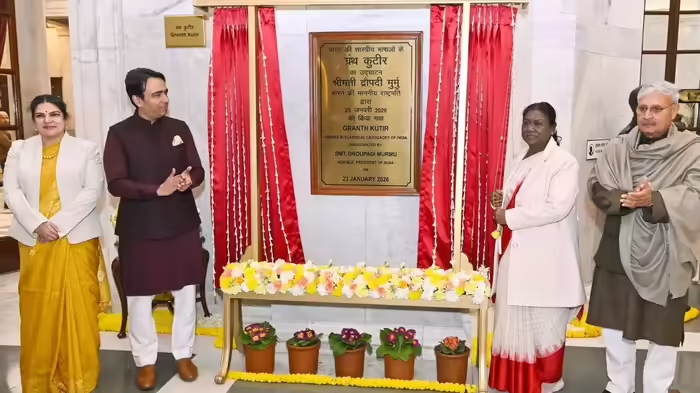
New Delhi: In a significant move to promote India’s civilizational heritage, President Droupadi Murmu inaugurated ‘Granth Kuteer’ at Rashtrapati Bhavan on Friday. The initiative replaces British-era literature with a curated collection of approximately 2,300 works in India’s classical languages, providing a dedicated space for India’s rich philosophical, literary, and intellectual traditions.
A Showcase of India’s Classical Heritage
According to an official statement, the collection includes works in Tamil, Sanskrit, Kannada, Telugu, Malayalam, Odia, Marathi, Pali, Prakrit, Assamese, and Bengali, spanning genres such as epic poetry, philosophy, linguistics, history, governance, science, devotional literature, and India’s constitution in classical languages. The collection also houses nearly 50 manuscripts written on traditional materials like palm leaves, paper, bark, and cloth.
Previously, Rashtrapati Bhavan held British-era texts such as original works by William Hogarth, speeches and administrative summaries by Lord Curzon of Kedleston, and biographies of Lord Curzon. These works have now been relocated to a separate archival space, digitized, and made accessible to researchers and scholars online.
Purpose and Vision
The statement highlighted that Granth Kuteer aims to raise awareness about India’s cultural and literary heritage while aligning with the national resolve to move beyond colonial influences. The initiative also supports the Gyan Bharatam Mission, which seeks to preserve, digitize, and disseminate India’s vast handwritten legacy by integrating tradition with technology.
In 2024, the central government recognized Marathi, Pali, Prakrit, Assamese, and Bengali as classical languages, bringing the total number of classical languages in India to 11. The Indira Gandhi National Centre for the Arts (IGNCA) is providing professional expertise for the preservation, documentation, and display of these manuscripts.
President Murmu on the Significance of Classical Languages
Addressing the gathering, President Murmu said, “Classical languages have laid the foundation of Indian culture, guiding the world for centuries through knowledge in science, yoga, Ayurveda, and literature. Texts like the Tirukkural and Arthashastra remain relevant today, while Panini’s grammar, Aryabhatta’s mathematics, and Charaka and Sushruta’s medical treatises continue to inspire globally.”
Emphasizing the need for their preservation and promotion, she urged universities to enhance classical language teaching, encouraged youth to learn at least one classical language, and called for making such works more widely available in libraries.
it more eye-catching for readers.
Discover more from SD NEWS agency
Subscribe to get the latest posts sent to your email.