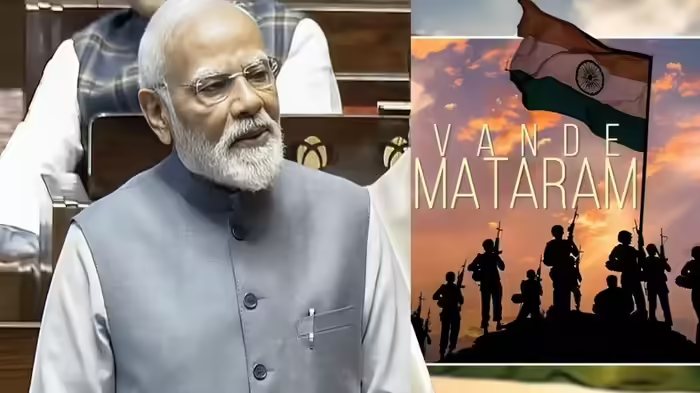
New Delhi: The Indian Parliament witnessed a lengthy debate over the national song ‘Vande Mataram’ as it marks its 150th anniversary. The discussion, held in a special session of the Lok Sabha, is expected to last over ten hours, with Prime Minister Narendra Modi taking part. A similar discussion is scheduled in the Rajya Sabha, where Home Minister Amit Shah will speak.
Historical and Political Significance
Written in the 1870s by Bankim Chandra Chattopadhyay, ‘Vande Mataram’ holds a special place in India’s political and cultural history. It was first published in Chattopadhyay’s Bengali magazine Bangadarshan in 1875 and later featured in his novel Anandamath (1882). The opening Sanskrit lines depict India as the goddess Durga, while the Bengali verses celebrate the motherland’s beauty and spirit.
The song gained momentum in the late 19th century, with Hemchandra Banerjee performing it at the 1886 Congress session in Kolkata. Rabindranath Tagore’s musical composition in 1896 brought it into public political discourse, turning it into a rallying cry against colonial rule. By 1905, it became a symbol of resistance during the Swadeshi movement and protests against Bengal’s partition.
Roots of Controversy
Despite its iconic status, ‘Vande Mataram’ has long been politically sensitive, particularly regarding its religious imagery. From 1906 to 1911, the Muslim League objected to the references to deities in the song, leading Congress leaders to limit its official use to the first two stanzas. Mahatma Gandhi endorsed the song but urged caution regarding its religious tones. In 1937, Congress formally adopted only the first two stanzas for official purposes. After independence, the Constituent Assembly recognized it as the national song alongside ‘Jana Gana Mana’ on 24 January 1950.
Parliamentary Debate and Political Arguments
Prime Minister Modi criticized the 1937 decision to truncate parts of ‘Vande Mataram’, calling it divisive and arguing that it undermined the song’s role in nation-building. Modi emphasized the importance of educating the younger generation about the song’s full historical and patriotic significance.
In response, Congress defended the decision, citing the need for unity during the independence movement and referencing leaders like Gandhi, Nehru, Sardar Patel, Subhash Chandra Bose, Rajendra Prasad, Maulana Azad, and Sarojini Naidu. Congress also referred to a letter by Tagore to Nehru, which recommended limiting the song to two stanzas to avoid offending sections of the Muslim community. The party accused the Prime Minister of distorting history to divert attention from national issues.
BJP spokesperson Sambit Patra indicated that the party would highlight historical disagreements, citing sources that revealed Nehru’s concerns about the association of Vande Mataram with Anandamath and potential objections from the Muslim community.
Legacy of ‘Vande Mataram’
Over 150 years, ‘Vande Mataram’ has remained a symbol of patriotism and resistance, inspiring freedom fighters and shaping political discourse in India. While its religious imagery continues to evoke debate, its historical significance as a unifying anthem of the freedom struggle is undeniable.
Discover more from SD NEWS agency
Subscribe to get the latest posts sent to your email.