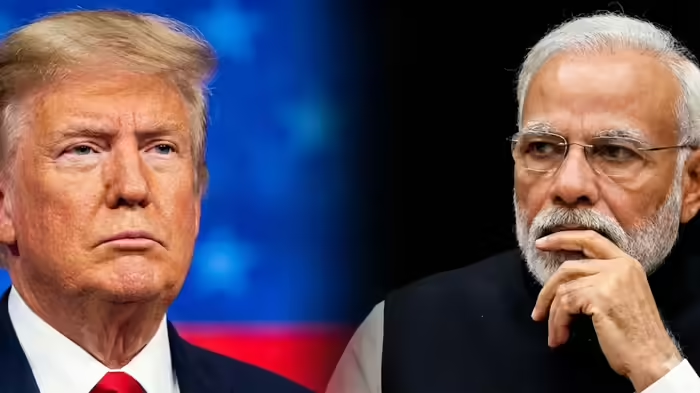
As global attention turns to fresh efforts to stabilise West Asia, India faces a complex diplomatic choice after being invited to join US President Donald Trump’s newly launched “Board of Peace” (BoP)—an initiative aimed at reinforcing a ceasefire in Gaza and overseeing a temporary governance framework in Palestinian territories.
The United States has extended invitations to nearly 60 countries, including India, to be part of the three-year body. However, New Delhi has not yet indicated whether it will accept the proposal. Notably, several major powers such as France, the United Kingdom, China, Germany, Sweden and Norway stayed away from the signing ceremony, while countries including Russia, Italy, Türkiye, Ukraine and Paraguay have refrained from making any formal commitment.
What Is the Board of Peace?
The BoP is designed as a multilateral mechanism backed by approval from the UN Security Council, according to US officials. Membership is limited to three years, while reports suggest that permanent membership may require a contribution of up to USD 1 billion, a condition that has raised eyebrows among policy experts.
India’s Long-Standing Balancing Act
India’s potential participation is complicated by its carefully balanced West Asia policy. Under Prime Minister Narendra Modi, India has significantly strengthened strategic and defence ties with Israel—emerging as its largest arms importer between 2020 and 2024, with bilateral trade nearing USD 5 billion annually.
At the same time, India has consistently supported the Palestinian cause. In 1975, it became the first non-Arab country to recognise the Palestine Liberation Organization (PLO) as the legitimate representative of the Palestinian people. India continues to operate a representative office in Ramallah, contributes USD 5 million annually to UNRWA, and advocates a two-state solution.
Analysts believe Trump’s initiative could place India’s established diplomatic posture under strain.
Experts Divided on India’s Participation
According to a report by Deutsche Welle, Indian foreign policy experts are sharply divided.
Mudassir Quamar, Associate Professor at JNU’s Centre for West Asian Studies, cautions that India would be “walking a diplomatic tightrope.” He points to Trump’s unpredictability, lack of clarity over the board’s operational structure, and the reported financial conditions for permanent membership. Quamar suggests India should consult regional partners such as Israel and the UAE before making any commitment.
On the other hand, T.S. Tirumurti, former diplomat and India’s first representative to the Palestinian Authority, argues that India should join the board. He believes the BoP could evolve into a geopolitical counterpart of the G20, especially as the US prefers to keep the G20 focused on economic issues. Tirumurti says India’s presence would ensure that the concerns of the Global South are articulated with credibility and balance.
Concerns Over Neutrality and Legal Ambiguity
However, Professor Sameena Hameed of JNU raises serious reservations. She highlights the legal ambiguities surrounding the board and the high political cost of participation. Hameed notes that while Israeli Prime Minister Benjamin Netanyahu has accepted the invitation, Hamas has been completely excluded, raising concerns about inclusivity and neutrality.
She also warns that the structure of the board appears to grant disproportionate authority to the United States, potentially undermining its impartiality. According to her, India may be better served by maintaining strategic ambiguity, a tool it has historically used to safeguard foreign policy autonomy.
A Cautious Path Forward
Some experts suggest that India should negotiate the terms of participation before taking a final call. If the board’s mandate remains confined to West Asia, India could contribute in non-military roles—such as medical assistance and humanitarian support for Gaza—in line with its long-standing peacekeeping and humanitarian traditions.
As global geopolitics grow increasingly polarised, India’s decision on Trump’s peace initiative may test its ability to balance principles, partnerships and pragmatism on the world stage.
Discover more from SD NEWS agency
Subscribe to get the latest posts sent to your email.