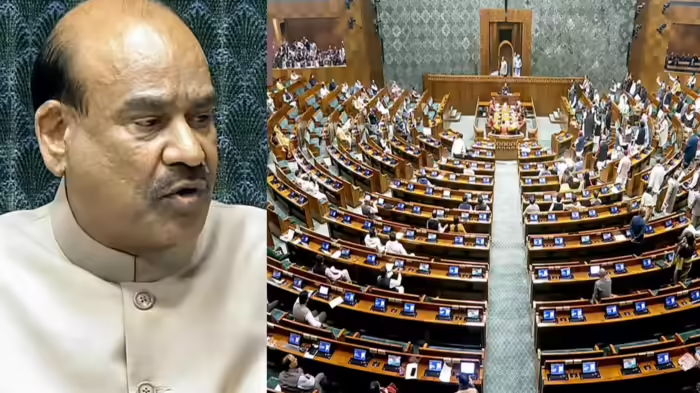
New Delhi: Amid the ongoing political deadlock in Parliament, the Opposition is reportedly considering bringing a motion to remove the Lok Sabha Speaker. While the Speaker’s office is regarded as a symbol of neutrality, constitutional dignity, and democratic balance, the Constitution provides a defined procedure to initiate action if serious questions are raised about the Speaker’s conduct.
According to former Lok Sabha Secretary-General P.D.T. Achary, the Speaker cannot be challenged through a no-confidence motion. Instead, a formal constitutional mechanism called a “Resolution to Remove the Speaker” is used.
Constitutional Provision for Speaker’s Removal
The process of removing the Lok Sabha Speaker is laid down under Article 94(e) of the Indian Constitution and also mentioned in the Rules of Procedure of the Lok Sabha.
As per the rules, any Lok Sabha member can submit a written notice to the Secretary-General of the Lok Sabha seeking the Speaker’s removal. Generally, such a notice is jointly submitted by two Members of Parliament (MPs).
The notice must clearly mention the reasons for removal and must include specific and well-defined charges against the Speaker.
Opposition Gets a Platform to Question the Speaker
P.D.T. Achary pointed out that although this constitutional provision has been invoked multiple times since Independence, no Lok Sabha Speaker has ever been removed through this process.
However, the motion carries strong political and parliamentary significance, as it gives the Opposition a rare constitutional opportunity to openly debate and criticise the Speaker’s functioning inside the House—something that is normally not permitted under standard parliamentary conduct.
Speaker Removal Motion Introduced Three Times
In the history of the Lok Sabha, the resolution to remove the Speaker has been introduced three times:
- December 15, 1954 – A motion was brought against the first Lok Sabha Speaker G.V. Mavalankar by Socialist Party leader Vigneshwar Mishra.
- November 24, 1966 – Socialist leader Madhu Limaye introduced a motion against Speaker Sardar Hukam Singh.
- April 15, 1987 – CPM MP Somnath Chatterjee moved a resolution against Speaker Balram Jakhar.
How Can the Lok Sabha Speaker Be Removed?
The rules state that once the notice is submitted, the motion can be listed in the House agenda only after a minimum of 14 days from the date of submission.
When the resolution is presented in the Lok Sabha, it must receive visible support from at least 50 MPs, who are required to stand in favour of the motion.
If the required support is obtained:
- The motion is taken up for discussion,
- A debate is conducted in the House,
- Voting is held.
The Speaker can be removed only if the motion is passed by a majority vote in the Lok Sabha.
A Rare but Powerful Parliamentary Tool
Though it has never succeeded in removing a Speaker, the resolution remains an important constitutional tool that allows lawmakers to raise concerns over the Speaker’s impartiality and conduct in a structured and democratic manner.
Discover more from SD NEWS agency
Subscribe to get the latest posts sent to your email.