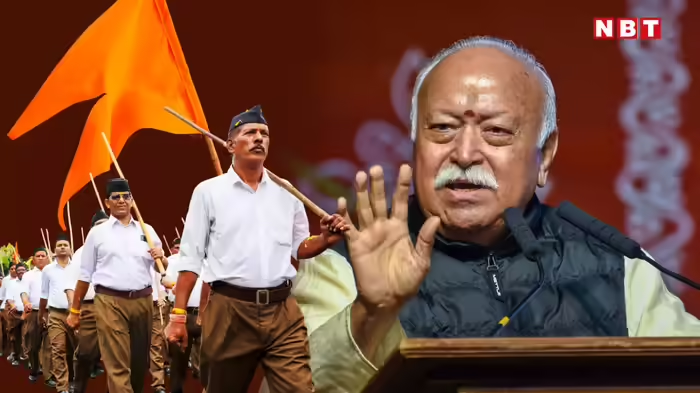
On the occasion of the 100th anniversary of the Rashtriya Swayamsevak Sangh (RSS), Sarsanghchalak Mohan Bhagwat spoke extensively about the organization’s achievements, challenges, and vision for the future. Addressing an audience at the Indira Gandhi Pratishthan in Lucknow, Bhagwat engaged in a 2.5-hour interactive session, discussing the RSS’s stance on contemporary social, economic, and political issues.
Tariff Disputes
On recent trade conflicts, Bhagwat expressed confidence in India’s ability to withstand pressure from powerful nations. “The recent tariff challenges will not deter India from leading the Global South. No country can intimidate us; we will stand firm, and matters will normalize soon,” he said, referring to the initial 50% tariffs imposed by the U.S. and the subsequent trade deal that reduced them to 18%.
Indian Economy
Bhagwat emphasized that the Indian economy is not solely in the hands of capitalists or banks, but also belongs to households across the country. He noted that despite pressures from powerful nations leveraging economic and military might, India has the resilience to progress.
UGC Regulation Controversy
Regarding the ongoing debate over UGC regulations, Bhagwat stated that the matter is currently under consideration by the Supreme Court, and the RSS’s position will depend on the court’s final judgment.
Temple Administration
On the politically sensitive issue of bringing temples under the control of devotees rather than the government, Bhagwat said, “We too demand that temple management be returned to the hands of devotees. Religious leaders and the public should collaboratively manage these institutions.”
RSS’s Incomplete Success
Bhagwat acknowledged the RSS’s century-long contributions but admitted that the organization’s mission remains unfinished. “The RSS has achieved much, but its success is incomplete because Hindu society is not united,” he said, calling for unity among Hindus in the national interest.
Biggest Challenge for RSS
When asked about the organization’s greatest problem, Bhagwat said, “The Hindu community remains indifferent to many issues. Instead of identifying themselves through various castes and sects, it is better to identify collectively as Hindus. Social harmony is the foundation of social unity.” He noted that caste distinctions are gradually diminishing, particularly among the younger generation, and predicted that once caste loses political significance, leaders exploiting caste divisions will also change.
RSS and BJP Relations
Addressing longstanding allegations that the Bharatiya Janata Party (BJP) is under RSS control, Bhagwat clarified that the BJP is an independent political entity. “Volunteers can join the BJP and contribute, but it is incorrect to say that the RSS controls the party,” he asserted.
Through this session, Bhagwat underscored the RSS’s vision for a unified Hindu society, the need for social harmony, and the organization’s continued engagement in national and socio-political discourse.
Discover more from SD NEWS agency
Subscribe to get the latest posts sent to your email.