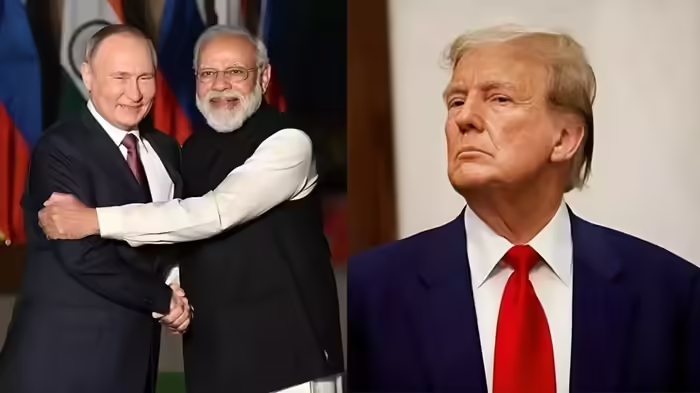
New Delhi / Moscow: The recent 23rd annual India-Russia summit sent strong geopolitical signals that have caught the attention of the United States, China, and Europe. Both nations reaffirmed their commitment to deepen cooperation in sensitive sectors such as defense and nuclear energy, driven not by fear of any third country but by mutual national interests.
Strategic Autonomy at the Forefront
The summit emphasized that India will shape its bilateral relations based on its own interests, not under pressure from any other nation. Prime Minister Narendra Modi and Russian President Vladimir Putin discussed a wide range of areas including nuclear energy, defense, and strategic technologies, highlighting the enduring friendship between the two nations.
China Factor and Defense Cooperation
Russia has transferred S-400 missile systems and other advanced defense technologies to India. While these systems enhance India’s capability to respond to threats from Pakistan, they also serve as a counterbalance to China, reflecting Russia’s commitment to its long-term strategic partnership with India.
Additionally, Russia has approved the sale of BrahMos supersonic cruise missiles to the Philippines, amid its ongoing dispute with China in the South China Sea, signaling that it has no hesitation in equipping India with capabilities that may challenge Chinese interests.
Russia’s Superpower Ambitions
The India-Russia partnership indicates the emergence of a new strategic pole in a multipolar world. With U.S. President Donald Trump advocating a bipolar world dominated by the U.S. and China, the question arises whether India and Russia can jointly form a powerful alternative bloc. Russia, a self-proclaimed superpower, is unlikely to accept the dominance of a U.S.-China alliance.
Pressure on the United States
Russia has leveraged its position to compel the U.S. to negotiate a settlement with Ukraine, ensuring NATO’s expansion does not extend to Ukraine. Post-agreement, the removal of Western sanctions on Russia will facilitate deeper trade ties with India. This development strengthens India-Russia bilateral interests and supports the rise of a new global pole, potentially limiting the U.S.-China bipolar framework.
Implications for India
For India, the evolving Russia-U.S.-China dynamic is favorable. As Western sanctions on Russia ease, trade and defense deals will become more viable, allowing India to enhance its strategic autonomy and secure its interests in a multipolar world.
Western Concerns and China’s Ambitions
The West is wary of China’s ambition to assert dominance across the globe, particularly in the South China Sea and Taiwan. The Quad alliance, led by the U.S., was formed to counterbalance China, but recent policy missteps have emboldened Beijing. In this context, India-Russia collaboration offers a strategic pathway to form a distinct global pole, balancing both U.S. and Chinese influence.
Discover more from SD NEWS agency
Subscribe to get the latest posts sent to your email.