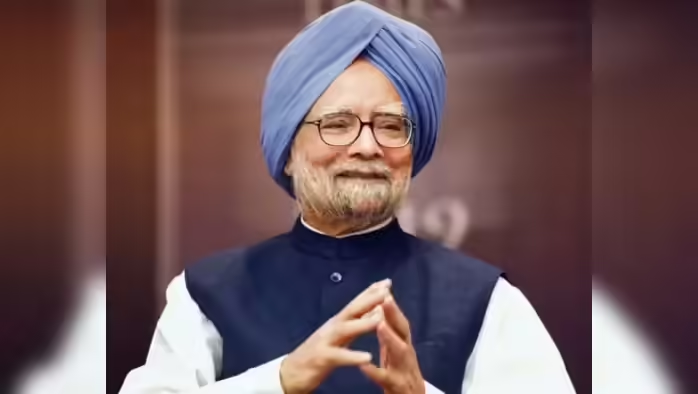
“Better than a thousand answers is my silence; it preserves the dignity of countless questions.”
These words by Dr. Manmohan Singh perfectly captured the essence of a man who held one of India’s most powerful offices yet chose restraint over rhetoric.
On the death anniversary of India’s former Prime Minister, the nation remembers a leader whose silence often spoke louder than words. Born on September 26, 1932, in undivided Punjab, Manmohan Singh’s journey to the highest political office was shaped more by circumstance and service than ambition. Before entering politics, he was a distinguished economist and academic, with no mass political base and no victory in a Lok Sabha election. He reached Parliament through the Rajya Sabha — and from there, went on to lead the country for a decade.
A Prime Minister Shaped by Circumstances
Manmohan Singh became Finance Minister first, and later Prime Minister, driven by the demands of the moment rather than political maneuvering. During his ten-year tenure (2004–2014), India witnessed significant economic growth and global recognition. At the same time, his government also faced serious challenges, including allegations of corruption that engulfed the administration and tested his leadership.
Despite these storms, Singh remained calm, composed, and dignified — traits that both defined and complicated his public image.
The ‘Silent’ Prime Minister
Critics, particularly from the opposition, often portrayed him as a “weak” or “remote-controlled” Prime Minister. Veteran BJP leader L.K. Advani once remarked that the importance of the Prime Minister’s residence at 7, Race Course Road (now 7, Lok Kalyan Marg) had diminished under Singh’s leadership.
Yet, this narrative of silence was often misleading. In response to repeated criticism, the Prime Minister’s Office once clarified that during his decade in office, Manmohan Singh delivered nearly 1,198 speeches — roughly one speech every three days. His former media advisor, Pankaj Pachauri, revealed these figures to counter the perception that Singh rarely spoke.
Integrity as His Greatest Strength
Accusations that he was merely a figurehead never stuck firmly, largely because of his personal integrity. In a political landscape frequently marred by scandal, Manmohan Singh’s reputation for honesty remained intact. It was this moral authority that ultimately helped him weather relentless political attacks.
On August 27, 2012, within the Parliament complex, Singh quoted the couplet that came to define his philosophy of leadership — choosing dignity over noise, restraint over confrontation.
A Quiet Legacy
Manmohan Singh was not a leader of fiery speeches or dramatic gestures. He believed in governance through intellect, patience, and quiet resolve. His silence was not emptiness; it was contemplation, discipline, and conviction.
On December 26, 2024, Dr. Manmohan Singh bid farewell to the world, leaving behind a legacy written not in slogans, but in substance. In an era of loud politics, he remains remembered as the Prime Minister whose calm presence and unspoken words left an indelible mark on Indian democracy.
Discover more from SD NEWS agency
Subscribe to get the latest posts sent to your email.