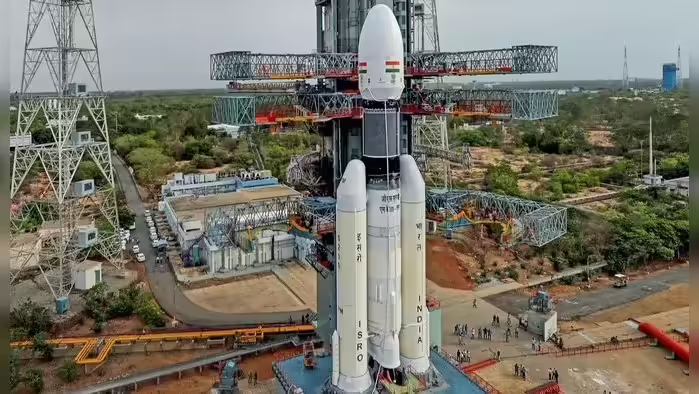
India suffered a significant setback in its space programme on Sunday as the PSLV-C62/EOS-N1 mission failed to achieve its objective, despite a successful lift-off from the Satish Dhawan Space Centre in Sriharikota. This was the Indian Space Research Organisation’s (ISRO) first mission of 2026, and it was considered strategically crucial for national security and advanced Earth observation.
ISRO Chairman V. Narayanan confirmed that while the launch vehicle performed normally during the initial phases, problems emerged toward the end of the third stage, ultimately leading to deviation from the intended flight path.
What ISRO Chief Said
Addressing the media, ISRO Chief V. Narayanan said:
“Today, we attempted the PSLV-C62/EOS-N1 mission. PSLV is a four-stage launch vehicle with two solid and two liquid stages. The performance of the vehicle was normal up to near the end of the third stage. However, towards the end of the third stage, we observed higher-than-expected disturbances. Subsequently, a deviation in the flight path was noticed. We are currently analysing the data.”
He added that telemetry updates were received with delays, and once the fourth stage was expected to ignite, communication updates stopped altogether, indicating a mission anomaly. ISRO has stated that a final conclusion will be drawn only after detailed data analysis.
Why PSLV-C62 Was Important
The mission was designed to deploy EOS-N1, a satellite developed for DRDO, making it highly significant from a national security and surveillance perspective. The satellite was intended to support:
- Strategic border and security monitoring
- Agricultural assessment
- Urban mapping
- Environmental observation
In addition to EOS-N1, the mission also carried multiple technology demonstration satellites from India and abroad, featuring applications such as on-orbit AI processing, IoT-based store-and-forward communication, radiation measurement, and agricultural data collection.
Mission Details
- Launch Vehicle: PSLV-C62 (PSLV-DL variant)
- Height: 44.4 metres
- Launch Pad: First Launch Pad, Sriharikota
- Mission Type: Commercial mission for NewSpace India Limited (NSIL)
- PSLV Milestone: 64th flight of PSLV and 5th mission of the PSLV-DL variant
ISRO initially stated that all four stages performed normally, but subsequent observations confirmed that the mission could not be completed as planned.
Second Consecutive Setback
This failure has raised concerns as it follows a similar incident last year. On May 18, 2025, the PSLV-C61 mission failed due to a third-stage anomaly, preventing the deployment of the EOS-09 Earth Observation Satellite.
With two consecutive PSLV missions encountering issues in the third stage, experts believe ISRO will now conduct a comprehensive technical review to ensure reliability, especially as upcoming flagship missions like Gaganyaan and Chandrayaan depend heavily on launch vehicle performance.
Looking Ahead
Despite the setback, ISRO has emphasized that failures are part of complex space missions and that lessons learned will strengthen future launches. The space agency is expected to release a detailed failure analysis report in the coming days.
For now, the PSLV-C62 mission stands as a reminder of the challenges inherent in space exploration—even for one of the world’s most reliable launch systems.
Discover more from SD NEWS agency
Subscribe to get the latest posts sent to your email.