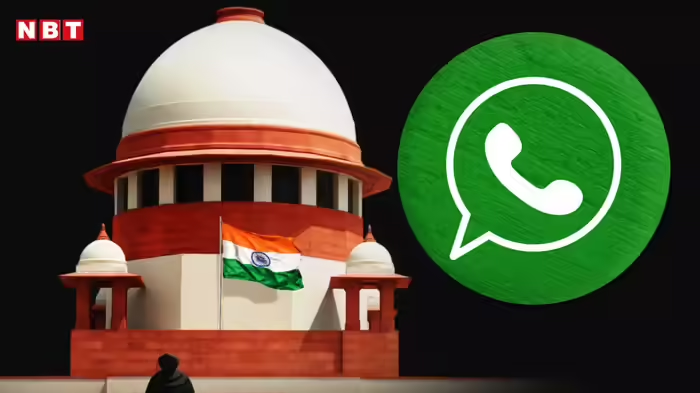
New Delhi: The Supreme Court on Tuesday sharply reprimanded social media giant WhatsApp and its parent company Meta over concerns regarding data sharing and violations of citizens’ privacy rights. Chief Justice of India (CJI) Suryakant warned that if these companies cannot comply with Indian law, they are free to leave the country.
The court emphasized that neither technology nor business processes can be used as an excuse to compromise citizens’ right to privacy. WhatsApp and Meta had approached the Supreme Court challenging last year’s decision by the National Company Law Appellate Tribunal (NCLAT). The apex court has directed the central government to be made a party in the matter and is expected to issue an interim order on February 9.
“If You Cannot Follow the Constitution, Leave India”
Addressing WhatsApp, CJI Suryakant said, “…we will not allow you to share even a single digit of our citizens’ data.” The court also reacted strongly to the companies’ commercial intentions, calling out “exploitative” practices. “If you cannot comply with our Constitution, you can leave India. We will not allow citizens’ privacy to be compromised,” the CJI asserted.
Privacy Rights Cannot Be Compromised
The Supreme Court further criticized WhatsApp and Meta for allegedly using user consent and opt-out mechanisms as loopholes to collect private data. The bench noted that these practices are “easy ways to steal personal information” and are unacceptable under Indian law.
213 Crore INR Fine on WhatsApp
The case relates to WhatsApp’s 2021 privacy policy update. Last November, NCLAT upheld a ₹213.14 crore fine imposed on WhatsApp and Meta by the Competition Commission of India (CCI) for exploiting their dominant market position to enforce the policy changes. The companies have now challenged this order in the Supreme Court. The court has also added the Ministry of Electronics and IT (MeitY) as a party and will hear the matter further on February 9.
“Privacy Rules Are Deliberately Complicated”
During the hearing, the court observed that privacy rules set by major tech companies are often deliberately complex, leaving citizens confused. The bench questioned the so-called opt-out mechanisms and noted that such practices cannot justify data sharing or user consent in India.
The Supreme Court’s stern warning underscores India’s commitment to protecting its citizens’ privacy and holding global tech firms accountable to local laws.
Discover more from SD NEWS agency
Subscribe to get the latest posts sent to your email.