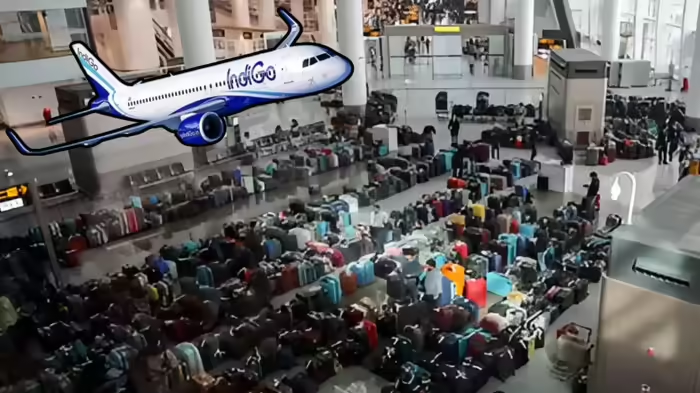
The recent week-long disruptions across IndiGo’s network have exposed a long-ignored truth: air passengers in India have virtually no power, and the airline industry is fully aware of it. Unlike global markets, where passengers can demand compensation for operational failures, India’s system allows airlines to neglect responsibility without any financial penalty.
A Pattern of Systemic Collapse
IndiGo’s crisis followed a familiar pattern observed in mature airline markets worldwide: over-optimization, minimal reserves, and limited staffing. Even minor errors—like rostering mistakes, IT failures, or weather disruptions—can cascade across the network.
- Europe (2017): Ryanair faced massive cancellations—20,000 flights in six months—due to pilot shortages and roster errors.
- USA (2022): Southwest Airlines’ outdated crew scheduling software failed during a snowstorm, leading to 16,700 cancellations in 10 days.
- UK (2017 & 2022): British Airways faced IT failures that halted check-in, baggage, and dispatch functions, affecting hundreds of flights in a single day.
In all cases, the structure was the same: high utilization, lean staffing, and zero buffer, resulting in network-wide collapse. IndiGo’s failure fits this pattern, but with a critical difference: the trigger here was entirely predictable, and the airline had 18 months to prepare for revised pilot duty-rest rules by 1 November.
The IndiGo Difference: Indian Passengers Have No Compensation
Unlike Europe and the USA, Indian passengers are not entitled to financial compensation for flight delays or cancellations, no matter how long or avoidable. Under EU261, Ryanair and British Airways provided €250–600 per passenger, along with food, hotel, rerouting, and refunds. Southwest reimbursed lodging and offered loyalty points. In India, the solution is often limited to meals and refunds—hardly a deterrent for operational negligence.
Market Structure Favors Airlines
India’s domestic aviation market is highly concentrated, with IndiGo controlling 65% and the Tata Group 27%. The Herfindahl-Hirschman Index (HHI) for India stands at 4,936, indicating a near-monopoly environment. By comparison: the US (~1,600), Brazil (~3,400), China (~2,500). A concentrated market gives passengers no alternatives, and failures impose no financial penalty on airlines, allowing negligence to persist.
Pilot Fatigue Rules and Operational Risks
Recent amendments to pilot duty-rest regulations were intended to reduce fatigue, a global cause of aviation accidents. However, when airlines can bypass or mismanage these rules, passengers bear the consequences—delays, cancellations, and potential safety risks.
Investigations Without Accountability
Over the past 15 years, India has seen three major commercial airline crashes. Investigations under International Civil Aviation Organization (ICAO) rules focus on understanding causes, not assigning blame. Human error, flight dynamics, automation issues, or fatigue-related decision chains often remain unresolved, leaving passengers and pilots bearing the cost of systemic failures.
Passengers Have No Escape
Indian passengers are expected to pay, wait, and endure—while the airline industry continues to enjoy heavy taxation benefits and near-zero operational penalties. Until regulations change, passengers will remain trapped in a highly concentrated, low-accountability aviation system, returning to the same check-in counters no matter how badly the network fails.
Discover more from SD NEWS agency
Subscribe to get the latest posts sent to your email.