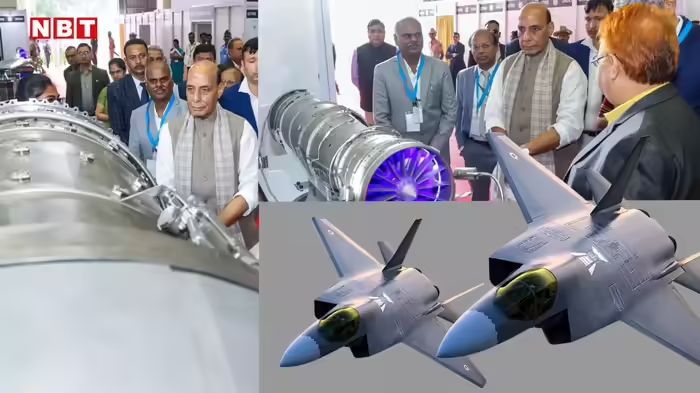
New Delhi: The Indian government is taking a major step toward self-reliance in fighter jet technology, emphasizing rapid development of indigenous engines for fifth- and sixth-generation combat aircraft. Under the National Aero Engine Mission (NAEM), Defence Minister Rajnath Singh on Monday announced that India aims to develop advanced fighter jet engines within the next five to seven years.
Focus on Sixth-Generation Jet Engines
India’s Defence Research and Development Organisation (DRDO) has been tasked with achieving this ambitious target, building on nearly two decades of experience in aero engine development. Minister Singh stressed that the strategic importance of these engines necessitates shortening timelines and accelerating research.
During a visit to DRDO’s Gas Turbine Research Establishment (GTRE) in Bengaluru, he reviewed progress on indigenous jet engine projects. Speaking to scientists, he said: “Given our national security requirements, the time has come to complete these indigenous engines. We cannot limit ourselves to fifth-generation technology; we must start work on sixth-generation fighter jet engines immediately.”
Progress on Fifth-Generation Stealth Jets
Indian scientists are currently working on prototypes of the Advanced Medium Combat Aircraft (AMCA), a fifth-generation stealth fighter. While the aircraft may take at least a decade to reach the Indian Air Force, the government is already planning for future sixth-generation engines.
5–7 Year Timeline for Development
Minister Singh acknowledged the complexity of aero engine development, which requires expertise in thermodynamics, material science, fluid mechanics, and advanced mechanical engineering. He noted that even developed countries take 25–30 years to produce next-generation engines. “Twenty years have already passed,” he said. “Now we have only five to seven years to meet our strategic requirements.”
Kaveri Engine and Advanced Fighter Development
The indigenous Kaveri engine project has experienced significant delays over the decades. At GTRE, Minister Singh observed tests of the afterburner engine designed for advanced fighters. “We are rapidly moving toward design and development of advanced medium combat aircraft. Our previous efforts have built expertise in aero engines; now it is time to complete the mission,” he stated.
National Aero Engine Mission and International Collaboration
Under the National Aero Engine Mission, India is also collaborating with the United Kingdom and France for joint studies and development of aero engines. Minister Singh highlighted that both countries possess advanced engine technologies. “These collaborations will not only allow us to learn cutting-edge technologies but also understand the challenges faced by other nations over past decades,” he said.
India, in partnership with France, is developing a 120-kilonewton engine for integration into the AMCA program, marking a critical step toward strategic self-reliance in indigenous fighter jet propulsion.
Discover more from SD NEWS agency
Subscribe to get the latest posts sent to your email.